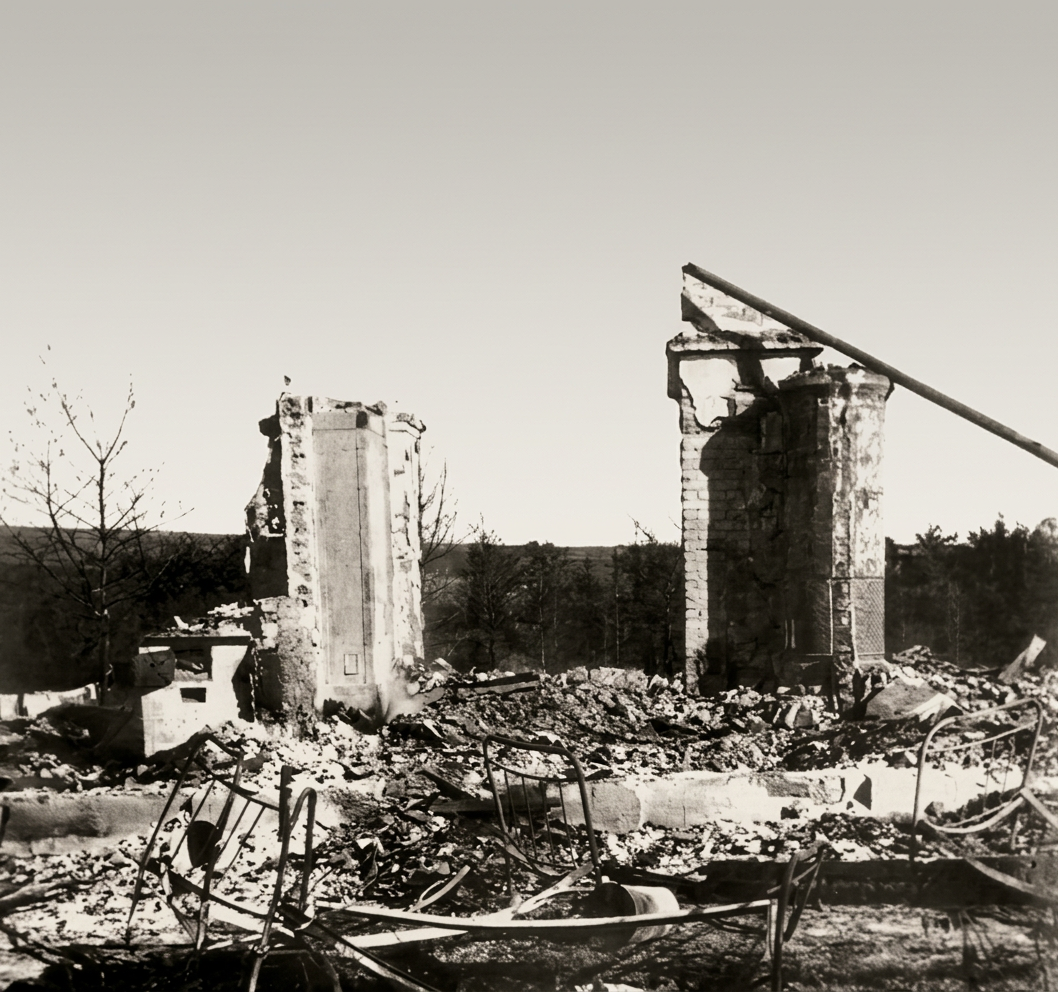
The destroyed Maslenki border station. AI Enhanced image
One of the usual interpretation by Russian historians that in the events of 1940 no military force was involved and Latvia was annexed voluntary. However they tend to forget the events of the June 15 1940 when Soviet Special Forces raided the Latvian border guard station Maslenki, killing and capturing many border guards and their wife’s. With all known rules of military warfare this can be seen as an act of aggression and invasion, as the Latvian border was crossed and its soldiers and civilians attacked. It was intended as provocations to force Latvia submit to the Soviet demands and allow unrestricted entry into Latvian soil. Also it was a clear warning of what would happen if the Latvian government would not accept the Soviet demands.
Maslenki today is a part of the Russian Federation as it was located in Abrene district that was part of the Latvian Republic from 1920 to 1944 after it was included in the Russian Soviet Socialist Federative Republic. After the fall of the Soviet Union it remained as part of the Russian Federation with no great chances of ever returning it to Latvia.
The border between Latvia and Soviet Russia was established in 1920 according to the peace treaty. The Abrene district was mostly populated by Russian nationals, however Latvia saw this territory as important for its railway routes and special geographical situation making easier to defend the eastern border. Also it was earned in blood as Latvian army chased the Soviets away at this point. The Soviet government was forced to sign a peace treaty and give away this district. In the next two decades Abrene became important part of the Latvian state. Latvians moved there to establish farms and towns and army fortifications and border bases.
The border protection law was issued in 1928 and the task was entrusted to a Border Guard (Robežapsardzība), in 1935 it was renamed as the Border Guard Brigade that was split in three battalions. The third was the Abrene battalion. The battalion worked in guard stations that overlooked every kilometer. Later cordons were established. The border guarding was a tough work, as the Soviet spies and illegal immigrants and also criminals tended to cross the border.
After October 1939 when Latvia signed mutual assistance pact with the Soviet Union a greater importance was put on the border protection as every incident could mean the accusation of breaking the pact. Latvia was already in the undesirable situation as Poland was occupied by both Germany and Soviet Union and sizable Red Army garrison already stationed in Courland. In the summer of 1940 Germany opened the Western front and Stalin was sure that is the right time to “fix the Baltic problem”. For this a small provocation was required.
The June 14 1940 was a peaceful day for Latvian border guards and civilians of the Abrene district. Many came to Latgalian song and dance festival in Daugavpils. 24 choirs with 1101 singers and 55 instrument players went there forming the second largest delegation. By the presence of the president Kārlis Ulmanis the song and dance festival marked the last normal day in Latvia for many years to come. Meanwhile the border guards organized the sport instructor courses. At the same time in Paris the German army marched on the main streets, but in Estonia two Soviet bombers shot down the Finnish civil airplane Kaleva (Junkers -52) over the Strait of Finland. Soviet submarine prevented the rescue or search of the crash site and collected all the remains. An Estonian government made no protest to the USSR. Meanwhile the Soviet documents falsely stated that the plane was shot in June 23 meaning that it was done after the occupation of Estonia and therefore not an act of international piratism but a defense move by the Soviets. At 23:30 in Moscow the Lithuanian ambassador was summoned to the Kremlin to meet Molotov, where he gave the ultimatum that Lithuania had to accept until 10:00 in the morning.
The Maslenki or Lejnieki border station was one of the first border stations since 1920. The guard-house was a wooden building built in 1929/1930. The commander in charge was senior officer Frīdrihs Puriņš who was notorious for his drinking and brawls with Russian locals. Soviet border guards often tried to provoke him because of it. Despite that his experience in the war of freedom brought a great respect from his senior colleagues.
At Midnight a border guard brass band rehearsal took place. The night unusually cold, on guard post were Jānis Macītis and Pēteris Cimoška, one was patrolling other was hidden post. Kārlis Beizaks was resting on wait his shift to replace Cimoška.
On 2:30 25 special soldiers of the NKVD the Soviet secret service managed to cross the border at river Ludza. The NKVD had surrounded the border cordon from all sides. Around the guard-house a bags of grenades were placed excluding the main doors meaning that NKVD men intended to capture the border guards without a single shot. The attackers were discovered by patrolling Jānis Macītis. He followed the instructions that if the stranger is spotted, he must let him closer to 20-30 meters and only then call him to stop, so he will be surprised and wont use arms. However, this instruction did not bear the fact that the stranger may have an automatic weapon. And precisely at this moment the NKVD men opened automatic fire at the Latvian border guard. Latvians only had shotguns that were useless in thick fog and bad visibility.
NKVD realized that they were spotted and turned to burn down the guard-house and kill all the border guards. Macītis was badly wounded and tried to reach the guard-house and stepped on the hand grenade and lost his left foot. A border guard on the disguised post Pēteris Cimoška opened fire, the enemy tried to locate his position to surround him. Cimoška retreated back to guard-house cause he heard other border guard Valdis Grīnvalds resisting. But he stepped on a bag of grenades and were torn in pieces.
In the guard-house Valdis Grīnvalds was desperately trying to hide from Soviet bullets that fired through the walls. As the visibility was bad he fired back without no aiming. Kārlis Beizaks also in the house decided to flee and jumped out of the window. He managed to run 199 meters passing house of Žanis Krieviņš that also was surrounded by NKVD men who killed Beizaks. They even threw grenades at him. Since some resistance was shown from guard house the NKVD threw inside the burning liquid and the house went on flames.
In the apartment room of the guard-house the commanders Frīdrihs Puriņš wife Hermīne and his 14-year-old son Voldemārs were caught up in the middle of the firefight. Hermīne jumped out of the window with a pillow in his hand to protect herself from the bullets. She was shot dead and later found in strawberry plants. Voldemārs run out of the doors and escaped and hid in a nearby pile of firewoods. Soviet attacker had been under cover there and shot Voldemārs in the stomach and foot. Valdis Grīnvalds left the house at the same moment and made way to the river where he was captured by the soviets.
NKVD also assaulted the border guards Žanis Krieviņš house. He was there with his wife Lida, son Artūrs and five year old Rita. Two grenades were thrown in. Lida was wounded as Soviets broke in took away his husband and children.
As the resistance was put down, the Soviets started to evacuate their killed and wounded men. However, because of the poor visibility they left many of their displaced war equipment. Soviets also abducted two civilians Olga and Dimitry Maslov. As Latvian reinforcements arrived at the scene the Soviets had left with guard-house burned down, three guard men killed, commanders wife shot, his son wounded and many people abducted.
At the same time Soviets attacked the other guard post at Šmaiļi. Here Soviets managed to capture the border guards without a fight. Also local civilians were taken as hostages. Also another attack was planned at Žuguru station. However, the plans were thwarted because the border guard’s wife Marianna turned 25 and border guards threw a big party. This became known by commander Voldemārs Gailītis and he came there with his men to inspect. On the night the border guard Kronis fired the signal pistol alarming the guards on duty and the guests. On June 16 they found a Soviet camouflage suit and wire breaking scissors nearby. It could be that Soviets were scared away by the sudden arrival of the commander himself and his men. The guard Kronis who spotted the Soviet intruder fired a signal rocket and loud talking by alarmed guests confused the NKVD men and made them turn back.
The Soviets had taken away 37 men and women and children. Latvian border guards were put on the alarm. But, Latvian government made no direct action or even protest against the USSR. In June 15 Lithuania submitted to Soviet demands and allowed entry of the Soviet forces. Lithuanian president Antan Smetona fled to Lithuania. Worlds eyes were on France it seemed hopeless to make any significant move. Latvia made an investigation commission on the incident but that was it. In June 17 Soviet forces entered Latvia. The border guards were told not to resist, they had plans for it, but now the border became open to the enemy. On the night between 16 and 17 June all main roads in Latvia were cleared of mines. If Latvian border guards showed some resistance there would be no myth of the peaceful occupation of Latvia and the removed district of Abrene.
In July 7 1940 Soviets sent back to Latvia their 37 hostages. The captured guards were submitted to interrogation. The later events, the occupation and war put them on the extremes again. The only one who did not return was Dimitry Maslov who was an agent of the Latvian Secret Service. He was executed in 1942 at Astrakhan prison.
The attack on Maslenki was intended to force the Latvian government to accept the Soviet demands. Soviets blamed Latvia for this tragedy and interpreted as a breach of the mutual agreement pact, that was one of the reasons why the Soviets demanded the full entry of the Red Army. Also it was a revenge by the NKVD to Latvians for the actions of their secret service on the Soviet border. The attack was also made to test the Latvian army leadership, fearing it may order full resistance, instead Latvian leaders showed confusion and weakness. However, the attack on the Latvian border station must be seen as an act of aggression and treachery that shows that the occupation of Latvia was brutal and bloody not peaceful.
Used Sources:
Feldmanis, Andrejs Edvīns. (2002) Masļenku traģēdija – Latvijas traģēdija = Tragedy of Masļenki – Latvia’s tragedy.Rīga : Latvijas 50 gadu okupācijas muzeja fonds.
 Latvian History
Leave a comment