
VEF stands for State Electrotechnical Factory (Valsts Elektrotehniskā Fabrika). From 1919 to early 1990’s it was one of the biggest and most successful state enterprises in Latvia. Its main production was radios, telephones, Automatic Telephone Exchanges, and various electronic gadgets. In first 20 years of its existence it also produced Minox mini photo camera’s and even airplanes. In independent Latvia VEF was example of industrial recovery after the WWI and was highly regarded by the state and society. After WWII when Latvian was occupied by Soviet Union, the Soviet industrial policy makers saw the potential of the VEF and turned into one of the main radio and telephone producers in whole Soviet Union. VEF was not just a major factory it was also a social and cultural service a symbol of the state prosperity. During Soviet occupation Latvia was one of the most industrialized Soviet republics. It had its major backdrop – high workforce immigration that become crucial in late 80’s. During process of regaining independence the VEF leadership and workforce was divided in their views. While many supported the independence, others had their doubts how the VEF would survive the transition to capitalism and separation from the Soviet market. These doubts proved to be true: the VEF leadership and the state government mismanaged the privatization process and VEF fell into bankruptcy. The breakdown of the Soviet market, VEF secret connections with Soviet military industry, failure to enter western market and finding western investors lead to collapse. Hundreds of jobs were lost and factories abandoned. Today few companies and basketball club bear the name of VEF. VEF remains as symbol of the state industrial history.
The history in VEF has been discussed in this site before. This article is rather illustrative representation of history of VEF using illustrative material from official VEF publications, memoirs and TV broadcasts. Article aims to show VEF greatest achievements during the interwar period and Soviet period and its demise at the end of the 20th century.

VEF main montage corpus at the Brīvības gatve 216
On April 1919 as Postal and Telegraph Department’s repair workshops were established in Riga. During that time Riga was controlled by Latvian Socialist Soviet government. However, month later Soviets fled the capital city and workshops were taken over by Republic of Latvia government. The equipment was brought by Soviets from Tver in Russia. During 1915-1916 much of the industrial equipment was evacuated to Russia anticipating the German capture of Riga. The workshop was located in Post and Telegraph building in Aspazijas bulvāris 5 (now home for economic and history faculties). It also became home for Radio Latvia. As the workshop produced more equipment and required more workforce and work space it needed new location. At first on 1924 it was moved to Slokas iela 2 to five story lombard building (now State History Archive). Finally on 1928 the workshops were moved to abandoned buildings of Russian-German factory “Union”. “Union” was electrotechnical factory founded by German citizen Henrich Detman who on 1887 bought a plot of land near Pskov freeway at edge of the city. On 1899 designed by architect Henrich Shiel a marvelous neo-renaissance style building with sculpture of Zeus was built. More new buildings were built around it as the enterprise prospered. On 1915 the company along with its 3000 people were evacuated to Kharkiv. The company was transformed in to Kharkiv Electromechanical company that still works today.
Former “Union” buildings became ideal place for new state electrotechnical company. On 1929 the Postal and Telegraph company workshops were called the State Electrotechnical factory “Pērkons” (Thunder). Three years later it was renamed simply as State Elektrotechnical Factory – Valsts Elektrotehniskā Fabrika – VEF.

The main factory corpus at the former German-Russian company “Union” at Brīvibas gatve 216. Atop the tower a neon sign VEF was installed.

Areas around VEF became highly populated by its workers

VEF workforce

Material storage

Extrusion workshop

Material cutter

Extrusion process for creating chassis ans splinters necessary for radio production

Automatic extrusion presses

Workshop for creating extrusion tools

Cutting machine and hand polishing machine

VEF steel oven and sharping machine for cutting tools

Turning bench workshop

Turnery

Automatic turner. The size parts are measured by the microscopes

Cadmium baths for parts and tools

VEF abatement oven. Yielding pulling machine

Wire spining machine

Bakelite workshop

Elements workshop

Zinc bottom pole soldering machine

Zinc pole casing soldering machine

Parts workshop

Transformer coil spining

Transformer measurement equipment. Capacitor thickness measuring

Making condensers

Plywood factory for creation for enclosures for radios

Enclosure workshop

Polishing workshop

Polisher polishing the enclosures

Assembling workshop

Equipment tuning

Assembling the loudspeakers

Radio casing and final check up

Products are being packed and sent to storage

Electrical measurement laboratory

Measurement of the sound distortion and receiver calibration

Measuring the sensitivity and selectivity of the receiver

Material testing laboratory

Special measurement equipment workshop

Radio transmitter in Klaipēda, Lithuania assembled by VEF

VEF made radio transmitter

Transmitter “turning field”

Radio beacon for transmitting timed interval signals

VEF Radio Branch library

Factory sales bureau

VEF store in Estonia

VEF stores in Finland and Lithuania
During the interwar period VEF produced mainly radios, telephones and telephone exchange systems that were installed in Riga and other major cities. Factory produced all electronics that had any market demand – communication devices, phones, light bulbs, cameras, irons, radios, flashlights, as well as photo paper, work-tables, and even airplanes. On 1936 VEF became famous across the world with its Minox subminiature camera designed by Walter Zapp was first of its kind.
On 1940 Latvia was occupied and VEF was nationalized by Soviet government. While some of the factory executives and workers faced repressions, the factory continued its usual work until June 22 1941 when Latvia was invaded by Nazi Germany. Factory was managed by Nazi authorities but was in decay. On 1944 following Nazi retreat from Riga, factory was looted and several buildings were destroyed.
Soviet government made great efforts to restore pre-war factories and VEF became part of enormous Soviet industrial sector. Soviet policy was to assign specialization for its many republics. Latvia became the main producer of radios, telephones and other electronic equipment. Such industry never fully developed in Estonia and Lithuania. Closest rival to VEF and Radiotehnika was Minsk Radio Factory and several factories in Russia. VEF radio design was so good it was adopted by Minsk and other radio factories in the Union. Radiotehnika was other main radio producer in Latvia that produced more advanced radio receivers, however VEF became the most popular. VEF products were imported to Soviet satellite states and Western Europe. The five largest state companies were VEF, Radiotehnika, Alfa, Komutators and Elar (which produced components for the other four). In its peak in 1991, VEF employed 20,000 people. However, part of the production went for soviet military needs. Latvian industry greatly boosted the Soviet economy. According to latest researches Latvia as Soviet republic made greater payments for other Soviet republics then Moscow actually invested for Latvia. The fact that Soviet government overextended the Latvian industry brought to need of workforce from other Soviet republics. VEF working force was multi ethnic of Latvians, Russians, Ukrainians, Belarusians, Jews, ect. As before the war, the VEF was highly regarded as pillar of state economy and became symbol of Soviet Latvian industry.

VEF made creative ways to advertise their products. Author of the photo
In 80’s the round dials were replaced with button dial and telephones became more advanced
Manufacturing the Automatic Telephone exchanges
ATE measuring and testing


Production of conveyors. automatic assembly lines and other production items
VEF also attempted to use robots for mass production
While still lacking behind western industry the VEF reached great level of technical advancement
Early computers were also used by VEF
A large dictionary would be needed to list all notable VEF workers and executives


VEF was always closely watched by the Soviet Communist party
VEF made contacts with counterparts in Eastern Block. Ideas were exchanged.
While VEF did not made much contacts with leading Western producers some contacts were made with Asian countries
VEF was not just a major factory. It offered a vast social welfare possibilities for its workers. VEF run sanatoriums, kindergartens, sports schools and Palace of Culture and Technology. Being a worker for VEF meant to be member of special social caste who received many advancements and privileges.

“Vefietis” public catering center located next to new soviet built VEF blocks was one of the most advanced in Latvia. Now demolished


VEF Palace of Culture and Technology located near central VEF complex was place of various cultural activities
VEF palace had library, young technicians learning center and artist workshop
VEF Palace hosted worker meetings, had VEF history museum and own choir
1989 VEF marks its 70 birthday. VEF veteran A. Bērziņš in charge for finding and creating parts for Minox camera gets awarded
On 1989 VEF celebrated its 70 years of work. Around that time the country affected by Perestroika was ridden with protests against increasing industrialization and immigration. What first started as massive environment protection protests turned to major movement demanding restoration of independence and the end of Soviet occupation. Many workers of the VEF joined the movement. Latvian Popular Front established a branch in the VEF factory. Mostly Russian speaking factory workers opposed this and supported the Interfront. On May 1 1989 flag of Latvia was raised above the VEF tower marking the official factory support for independence. Almost no one was sure at that time and until very August 1991 that independence is fully possible. And that’s why most did not consider what will happen afterwards the goal would be reached.
Flag of Latvia raised above VEF tower

Situation for VEF started to went downhill in 1991-1993. The Soviet market had collapsed, the connections with Soviet military was lost. VEF leadership failed to find efficient ways to enter Western market. In many ways the VEF production was already outmatched by western counterparts. The government instead of slow transition from communism to capitalism choose to allow the privatization of all state industrial enterprises. There was limited interest from foreign investors and the VEF leadership could not determine their new worth according to Western standarts. A decision was made to split the large VEF enterprise in several smaller companies. One by one these companies entered bankruptcy. In next decade VEF disintegrated; most factories were abandoned, some small companies bearing VEF name survived. Most successful is VEF Radiotehnika RRR that was born in uniting with Radiotehnika that also suffered major crisis after independence. Few other companies produced phones and electrical equipment but are too small to compete the western importers. VEF products soon became obsolete. The telecommunications provider Lattelecom choose foreign technology for new modern communications service. All governmental services ordered new foreign equipment and did gave any chance for VEF to modernize. VEF radios and telephones were obsolete in 10 years and now can be found as relics in flea markets and antique shops. Could VEF survived the transition and transformed into new modern company remains a open question. Some say that VEF breakdown was favored by rival companies who wanted to exclude it from free market. Others say that VEF breakdown was result of poor management, in which one blames another for their mistakes. VEF breakdown could also be inevitable – there was too many unfavorable factors that it simply could not survive in 90’s crisis. Similar fate awaited almost every major factory in Latvia. The breakdown of the industrial sector is the most crucial social disaster in Latvian history.

Crisis begins. No pays means empty factory with nothing but the birds

VEF workers gather in protest


Initial strong support for independence was now shadowed by strong disappointment as decades of work was lost

The leader of the Latvian Social Democratic Workers Party Juris Bojārs tried to stand up for workers with little success

Desperate call for government to save the VEF and do not be grave diggers of own state

Most factory buildings soon became abandoned. Factory equipment was either sold or stolen Some abandoned spaces as this sometimes is used to events such as markets or museum nights. The main assembly building is used by Goodwill nightclub. On the tower a ham radio transmitter is installed for local UHF radio club. This corpus where VEF airplanes were assembled was ruined for many years. Now is in the process of being restored.
Some former VEF buildings are now used by companies, shops, clubs, even religious organizations. Some still remains abandoned and sometimes are used by artists for their exhibits and workshops

Largest VEF factory building now serves as Domina Supermarket

The historic VEF building has been taken over by Latvian company Mikrotiks and has been renovated

VEF palace of culture kept his function as place for various cultural festivities and was home for VEF history museum. Since 2016 its been under renovation
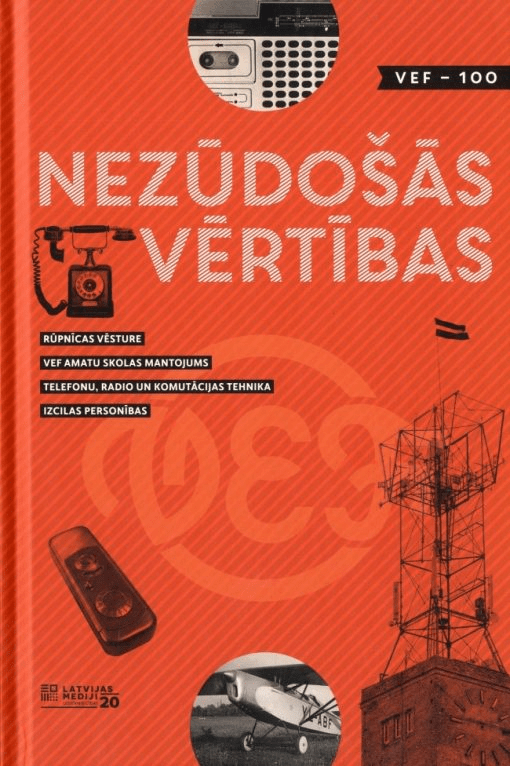
A full worded history of VEF was written few years ago. The pictures speak for themselves and they speak a thousand words of former glory and demise. Its doubtful VEF would ever be restored to what it was 25 years before. The preservation of the industrial heritage is important goal for our and future generations. 25 years after the demise of VEF its starting to become another subject of social memory about Latvian soviet and industrial past. Often full of myths so its important to preserve the history of the VEF, its workers and products they made. This article was dedications to all of them and I hope it will contribute to the memory and research about the VEF.
Used Sources:
VEF. Radio fotoattēlos. Rīga : Valsts elektrotehniskā fabrika, [1935].
Каталог / Рижское ордена Ленина и Октябрьской революции производственное объединение ВЕФ имени В. И. Ленина. Рига, 1987.
Bražis, Ivars, Minoksa mantinieki / Ivars Bražis ; redaktore / korektore un tekstu tulkotāja Alīna Melngaile. Rīga : Zvaigzne ABC, 2013

