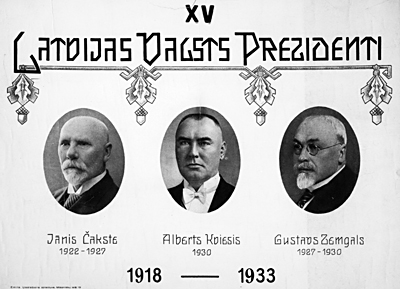
The three Latvian presidents – Jānis Čakste, Gustavs Zemgals and Alberts Kviesis
On November 14 1922 Jānis Čakste was elected as the first president of the independent Republic of Latvia. Since then Latvia had elected eight presidents. They could be more but because of the Soviet occupation the presidential institute was not working from 1940 to 1993. These first four presidents Jānis Čakste, Gustavs Zemgals, Alberts Kviesis, Kārlis Ulmanis have all been and are interesting personalities and played an important role in Latvian history. This article will tell more about them and about the presidential institute in Latvia.
When Latvia became fully independent after wining the war of independence in 1920 the new republic needed new constitution. So an interim parliament called Satversmes sapulce (The Constitutional Assembly) was elected to write a new constitution and rebuild the post-war state. One of the questions of the new constitution that Latvians called Satversme was the presidential post. How the president must be elected? What will be his authorities is Latvia is going to be a presidential or parliamentary republic? However, the leftist Social democrat workers’ party thought that Latvia doesn’t need a president at all, since it resembles monarchy and Latvia did not have such tradition in the past. They said the presidential institute will be too expensive and ceremonial and will be not in the interest of the worker masses. Instead they proposed to keep the Chairman of Saeima (Parliament) as the first head of the state that will not cost so much and will not be too aristocratic. But, the center right wing parties objected this and declared that Latvia as democratic state needs a president that could in the case of need limit the parliamentary powers and keep balance in the country.
Another question was if the president was supposed to be elected in popular statewide elections with high powers or elected by parliament with representative powers only. The right wing parties feared that the people could elect left wing populist candidate like popular writer and poet Jānis Rainis. The leftists on the other hand feared that the Kārlis Ulmanis the first Prime Minister of Latvia could be elected putting great obstacles for their goals. So in the end it was decided that the president will be elected by the parliament in three years in office for a maximum of two terms. The presidential candidate must be older than 40 years to be able to run for office. To start his office he had to give a ceremonial oath. The president had to represent Latvia in the international scene, appoint diplomatic representatives in foreign countries and meet with foreign diplomats. The president was the number one commander of the armed forces. The president had rights to give amnesty to sentence criminals, summon and lead the cabinet meetings, propose laws, and dissolve the parliament. However a referendum had to be called to dissolve the parliament completely, if the people vote in favor of the parliament the president must stand down. Also the parliament also had the rights to remove the president from his office and all of his orders had to be signed by the prime minister. Nothing much has changed today and the presidential authority is still strictly limited today despite numerous calls to make people elected president or to strengthen its powers. Such calls have always met opposition from coalition parties who don’t want to give up its powers.
Jānis Čakste 1922-1927
Jānis Čakste was a likely candidate to take the presidential post. Born on September 14 1859 in the Liesesava parish in Semigallia He finished the Juridical Faculty at Moscow University and worked in Jelgava as a secretary in Courland provincial prosecutor’s office however he was dissatisfied with his job and started personal practice as a lawyer. He took great action in social life lead the Jelgava Latvian society and was member in other societies. In 1888 he took the job as the editor of the newspaper “Tēvija” (Fatherland) where he defended the Latvian farmers against the misrule of the German barons his newspaper became the most popular in Courland.
His great speaker skills and national position made him popular and he was elected to First Russian State Council in 1906. His work in there was short lived as the Tsar of Russia Nicholas II dissolved the council. Čakste joined the public protest and was arrested and jailed for three months. During the World War I Čakste took an active role in leading and organizing the Latvian refugee live in Russia.
In 1917 after the February revolution he took work in Latvian interim national council foreign branch where he assisted to make memorandums for foreign countries. In November 17 1918 he was elected as the chairman of the Latvian Peoples Council the front institution of the new state. He however received this news with delay and could not join the proclamation ceremony of the Latvian republic on November 18 1918. In November 23 he was summoned to represent Latvia in foreign countries first in Paris peace conference. He spent there a half of the year and returned with positive news that he managed to make good foundations for the international state recognition of Latvia. At home he took the lead of the Latvian Peoples council that was sovereign interim power in Latvia and had rights to appoint governments.
In 1920 May 1 Čakste was elected as the president of the first Latvian elected parliament the Satversmes Sapulce (Constitutional Assembly) beating social democrat Rainis with 83 votes to 48. His great reputation the wise rule was enough to elect him as the president of Latvia in 1922 14 November. With a great majority of 92 votes and six abstaining with no votes against him was given a unanimous trust from the parliament. Kārlis Ulmanis and Jānis Rainis resented this as they wanted to be presidents themselves.
Čakste choose his office in the Castle of Riga. He started his working days early waking up at six of clock and taking walks across the streets. He had no enemies and he walked across the streets with no guards meeting the people walking by. His workday begun in nine of the clock where he gave instructions to his adjutant and secretary. Once a week a Prime minister and ministers visited him to inform him about the state affairs. President competent enough always gave recommendations and nothing was done without his word. He took the time to receive private visits from ordinary people and always left a good impression on everyone. He appointed 7 prime ministers, signed 402 new laws and took two diplomatic visits to Estonia and Finland.
Čakste was elected again in 1925 but did not live till the end of his second term; he died at 68 years on March 14 1927. A great national grief was among Latvians and 150 thousand people attended his funeral. In 1931 a great grave monument was erected at his resting place in Riga at Forest Cemetery that became a national symbol for years to come. In 2003 in Jelgava a monument dedicated to him was reveled in Jelgava.
Gustavs Zemgals 1927-1930
After the Čakste’s death his seat was temporarily taken by Saeima chairman Pauls Kalniņš. Already in April 5 a new elections were held. The right wing proposed Alberts Kvieisis the member of the Latvian Farmers Union who received 44 votes, the left wing candidate Pērteris Juraševskis the minister of interior with the Democratic Center got 41 votes. Since both of them did not get the required minimum 51 votes a second vote took place in 45 to 41 making Juraševskis to call off his candidacy. In third attempt Kviesis received 45 votes with 51 abstaining. Another Saeima extraordinary meeting was called in 7 April. Kviesis now headed against non party member Voldemar Zamuel with 43 votes to 44. In second vote they went tied at 47 votes and same tied at third attempt 43 to 43. Now Kviesis fought Fridrihs Vesmanis the first chairman of Saeima now an envoy in London, 47 with 39 votes was again not enough. In second try 44 to 47 and at third try with Kviesis dropping out Vesmanis received 45 votes. Again not enough.
The nine unsuccessful votes meant that a compromise figure was needed. Social democrats found it in the person of the Defense Minister Gustavs Zemgals. First Zemgals declined such offer thinking he is not suitable for such job. He however was talked into by foreign minister Fēlikss Cielēns and in April 8 he was elected by 73 votes to 23.
Zemgals finished the same Juridical faculty as Čakste and worked for 32 years as the head of the Riga craftsman support society savings and loans bank. He also took a role in the Latvian Theater building construction and edited many newspapers. After 1918 as well know figure he was a member of the Latvian Peoples council and deputy of Jānis Čakste. He took an important role in state matters.
Zemgals kept all the Čakste administration members and had good relations with them. He appointed two governments and widely used his amnesty rights amnestying 648 persons. He was the first president who took visit to Sweden to meet the king of Sweden Gustav V in landmark visit. Gustav V in return also visited Latvia. In his years of office he was a meditative figure between the various political forces and did not allow any extremes.
In 1930 Zemgals declined offers to run for second term. He however later decided to run for parliamentary elections and was elected in all following parliaments until 1934. He was a minister of finance from 1931 to 1932 and was an active member of parliament. He died at the age of 68 on 6 January 1939.
Alberts Kviesis 1930-1936
Same as Čakste and Zemgals, Kviesis was from Semigalia and was a jurist. He graduated the Tartu University and took an active role in Latvian refugee affairs. He became a member of Latvian Peoples Council and later the deputy of the chairman. In 1920 he was elected in Satversmes Sapulce and later in the Saeima. From 1921 to 1923 he took the office of the Interior Minister. He was the deputy of Saeima chairman in second Saeima. He has already run for the president’s office in 1927 but was defeated. Now in 1930 he runs again and again a 10 voting sessions were held until he was untimely chosen. He faced social democrat Dr. Paul Kalniņš. The far left party Workers and Peasants made things worse by proposing their member Miezis simply because Kviesis in Latvian means “wheat” but Miezis means “barley”.
Kviesis during his two terms of power resembled with his inactivity. He did not propose any new laws; he never took back any law back to parliament and never called any cabinet meeting. He only fulfilled his representative duties and was the most unpopular president of all. Kviesis was a great fan of music and took part in the organizing the Latvian Song and Dance festivals and opening them.
In 1933 he decided to run again facing Pauls Kalniņš as a competitor, but won in the first round with 52 votes to 25. Despite that Kārlis Ulmanis was from the same party as Kviesis (Latvian Farmers Union) he never informed him about his coup plan. On the night of May 15 1934 he was playing cards with his friends in the palace and was informed by plotters about the coup that has taken place. Kviesis despite being the high commander of the army and all the contacts never stepped against Ulmanis. Therefore he was kept as the official head of state while Ulmanis being the real ruler. The last time when he appeared in the public was in 1935 November 18 when he reveled the new Monument of Freedom. In 1936 his official term ended and he Ulmanis took the presidential office for himself. After that he again practiced jurisdiction and went off from politics. He stayed in Latvia during the Soviet occupation, was not deported but stayed under the soviet house arrest. After the 1941 German occupation he took a different step by joining the Latvian Self Government Juridical general direction in other words he became the Nazi collaborator. He led the general direction for one year until abstaining. In 1944 he with his family took on board the German ship to escape to Germany. He died on the ship on August 9 1944 while leaving the shores of the Daugava river. He was buried on the Latvian soil at Forest cemetery.
Kārlis Ulmanis 1936 -1940
There is a need for many separate posts about the life of Kārlis Ulmanis, his political carrier and Authoritarian rule. He was born in 1877 in the Courland Bērzmuiža parish. He took the agricultural education and traveled across Europe. He was arrested in 1905 during the revolution and exiled to US. He returned in 1913. Taking important post in the agricultural sector and scoring serious man reputation he achieved political recognition and became the Prime Minister of Latvia during the War of Independence.
He was elected in all parliaments and led many governments. But he was frustrated in democracy and feared the loss of power as his popularity shrink by every election so he gathered enough supporters to overthrow the government at May 15 1934. He was successful, the coup was bloodless and the Latvian people in the majority did not resist him. After Kviesis left the presidential palace all Ulmanis needed was to issue a law that made him acting president until the constitutional reform. No such reform ever took place so Ulmanis stayed as president until 1940.
The presidential post was only ceremonial and prestige for Ulmanis much of the time was still spent in the Cabinet of the Ministers. He finished is presidency in 1940 with an infamous speech saying “I will stay in my place you will stay in yours!”. In reality he was on house arrest and was forced to sign every law that the occupation government issued. He then was deported to the Soviet Union and died in Krasnovodosk, Turkmenistan 1942 20 September.
The presidential post was restored in 1993. The modern day presidency despite having nearly the same powers as before often has a different meaning and impact society. The story about Latvian modern day presidents will be told later on.
Used Sources:
Treijs, Rihards. (2004) Prezidenti : Latvijas valsts un ministru prezidenti (1918-1940) Riga : Latvijas Vēstnesis.
Bleiere, Daina, Butulis, Ilgvars, Stranga, Aivars, Feldmanis, Inesis and Zunda, Antonijs. (2006) History of Latvia : the 20th century. Riga: Jumava.
Bērziņš, Valdis. (Ed.) (2003) 20. gadsimta Latvijas vēsture. II Neatkarīgā valsts, 1918-1940 Rīga : Latvijas vēstures institūta apgāds.


Leave a Reply