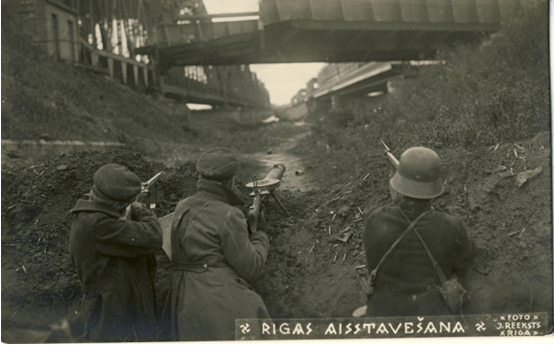
Latvian army defending Riga on November 1919
The August 11, is Latvian Freedom Fighters Remembrance Day. On this date in 1920 Latvia signed peace agreement with Soviet Russia. It was the end of 3 year war that was fought in all parts in Latvia against various enemies- the German Iron Division, The Red Army and the Bermont- Avalov army. Sadly there were battles that were fought by Latvians against Latvians. Latvia was the cross point of German, Soviet, White guard and Allied interests therefore newborn state of Latvia had many friends and foes. Without help of Estonian army, Polish army and Allied Warships Latvia would not won independence alone, but it was the strength and will of Latvian freedom fighters that helped to win the enemy majority.
On November 11 Latvian National Council defense department begun forming first armed forces. It was supported by Latvian Rifleman National Union who contributed 400 soldiers for the new army. While Latvians desperately searched for new soldiers, local Baltic Germans by the support of German occupation structures begun to form Baltic Landguard (Landeswerh in German) Even if the Germany had recently capitulated to Allies on November 11, local German forces were not going to leave Latvia for anytime soon. About 2600 volunteers joined the Landeswerh. They were sons of German noble families who wanted to defend their position against the Bolsheviks who were against the aristocrats.
The prospects of looming Soviet attack made Latvians and Germans unite their forces. Both sides mistrusted each other; Baltic Germans wanted their own state and viewed Latvian state with suspicion. Soviet attack begun on December. German army was defeated and Red Army quickly entered Latgalia. On December 6 Jānis Zālītis was admitted as the minister of Defence. The Red offensive was sweeping. The attack forces included Latvian Red rifleman, Russian divisions and International guards made from Chinese volunteers. This was one of the first time Latvians had contact with this nation and the Chinese soldiers were remembered as atrocious fighters.
Latvian national provisional government lead by Kārlis Ulmanis did not gained enough national support. He did not promise free land for all farmers as the Bolsheviks did. Latvian farmers and workers wanted land and bread now, the talk about national sovereignty was futile to them. Plus the temporary alliance with Germans was even more disliked by them.
On December 17 Latvian Soviet Socialist Republic was proclaimed. It was led by Pēteris Stučka a well-known leftist leader now turn to communist. His promise for free land to all was supported by majority of Latvians. Against him Latvian army only had Cesis Regiment, Student Regiment and other small volunteer units. It was too late to issue a draft.
On the beginning of 1919 German and Latvian governments evacuated from Riga. Latvian provisional government head to Liepaja. As the Soviets entered Courland; first battles between Latvians and Soviets were fought. Latvian forces were commanded by colonel-lieutenant Oskars Kalpaks. On the battle of Lielauce Kalpak’s men met face to face their red Latvian counterparts. On January 29 major battle happened at Skrunda at Soviet offensive was stopped. The front stabilized across river Venta. While Soviets gained success in Latvia, they faced defeat in Estonia where Estonian armed forces chased then away back to Narva and head to Valka. Soviets sent forces back to Valka, but could not defend it and Northern Vidzeme was entered by Estonian forces.
During the Bolshevik rule in most parts of Latvia, the land was nationalized; there were first attempts on making collective farms. Also ruthless terror on “enemies of the Soviet” took place. This led to popularity loss for Pēteris Stucka government.
In February Estonian army advanced in Vidzeme. Germans enlisted their strength by forming Iron Division led by German general Ridiger von der Goltz. He was strongly against Latvian independence and saw it as temporary obstacle. German forces made quick push back in Courland. Ventspils, Kuldīga and other parts were recaptured. Latvian forces followed the advance; however after accidental fire exchange with Germans Oskars Kalpaks was killed. He was replaced by Jānis Balodis. German- Latvian advance was successful as Jelgava was liberated and Riga was close.
In Estonian front with the Estonian support a North Latvia brigade led by colonel Jorģis Zemitāns was formed. It was first strongest Latvian unit with 2168 men. As Soviets faced more defeats their morale weakened and more and more Red Latvians deserted and joined national forces.
On the other side of the front Germans were weary about Latvian politics and advances. German leader general Rüdiger von der Goltz was aware of Latvian-Allied talks and Allied warship presence in the Baltic sea. This led to conspiracy in April 16 when Germans attempted to arrest Latvian government in Liepaja. Supported by Allied warships Latvian government escaped on board the ship Saratov. Goltz formed his own government led by Andreivs Niedra a pastor loyal to Germans. Germans started to attack Riga, on May 22 Germans captured Riga. Latvian army followed them but was unable to reach it first. Bloody battle took place in Kaugurciems were on the beach sands Latvians fought Latvians with bayonets. Germans made bloodshed in Riga by executing Bolsheviks and anti-German elements.
In mean time Estonian army captured Valmiera and Cesis. Soviets retreated to Latgale. While Latvian government still in exile on board the ship, Goltz now ordered to attack Estonian army as he wanted to defeat all Baltic national armies. In June 19 – 23, a battle at Cesis was fought between Germans and Latvian-Estonian armed forces. Battle was won by Latvians and Estonians. The German plan of making a German state in Baltic region failed.
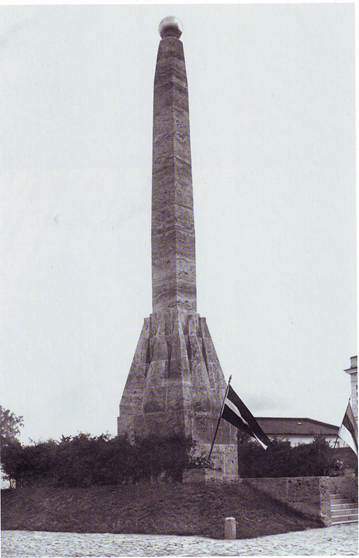
The Victory monument in Cēsis built in 1924, destroyed by Soviets in 1951. Restored in 1998
Allied forces made Germans to sign the Strazdumuiža truce on July 3. They were forced to leave Riga, however as the war in Russia went on and Latgale was still controlled by the Bolsheviks, allies allowed Germans to stay and re-deploy to fight against the Reds. Latvian government returned to Riga and North Latvia brigade made triumphed march on the streets of Riga.
Now when the majority of Latvians supported Latvian independence, Latvian army was empowered by volunteers. Many new divisions were formed and Allies added tanks and airplanes for Latvian army. Uniforms and new rifles were added to army as it was ready for further battles.
However in the mean time Germans had not given up the fight. In the district of Bauska where Goltz army was located more and more volunteers from Germany arrived. A Russian rotminster a self-declared duke Pavel Bermont managed to gain German trust and made his own army from Russian POW’S in German camps and formed the Army of Bermont. Bermont and Goltz allied together to form Western Russia volunteer army to fight Bolsheviks. Their forces consisted 52 000 men, with 3 armoured trains, 10 armed automobiles and 120 warplanes. Latvian army only had 11, 5 000 men with 1, armoured train, 3 armed automobiles and few warplanes.
On October 8 Bermont made swift attack to Riga and quickly pushed away Latvian forces to other side of the river Daugava. On October 10 Bermont’s army reached the bridges of Riga; however Latvians prevented the crossing and entrenched in Old Riga and around Riga palace. 3 Estonian armed trains came to help as the Allied ships came close to support Latvians. Bermont stopped the attack and the front line now was located between both sides of the city of Riga.
Latvian government turned down Bermont’s proposal for talks and on the October 11 started counter attack. Latvian army crossed river Daugava near Bolderaja and Daugavgriva. The attack was assisted by Allied ship cannon fire. The battle for Riga lasted from 3 November to 11 November when Bermont army was chased away from the city. The 11 November is celebrated as Lachplesis day the day military victory over enemy majority.
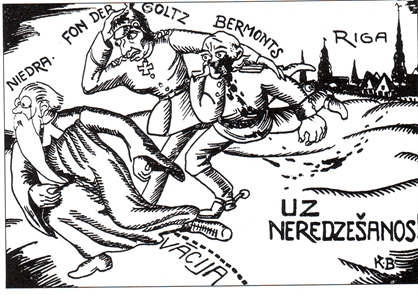
Bermont’s army was pushed back from all sides and in December the remains of his army crossed the Lithuanian border. He lost 5 thousand men, while Latvians lost 2 thousand. Bermont’s army soldiers were ruthless and atrocious. They engaged in killings of the civilians and burned houses and even the palace of Jelgava.
After complete defeat of German foe, only thing left was Soviets who still controlled Latgale. Since Estonia already had signed a peace agreement with Soviet Russia, Latvia made alliance with Poland. Together with Polish superior forces Latvians liberated Latgale. A peace agreement was signed in August 11. Soviet Russia promised to forever respect Latvian independence and newer engender it. “Forever” was until 1940, when Joseph Stalin decided to end Latvian independence.
Latvian war for freedom was tough and complicated time. Facing many superior enemies Latvians overcome their differences and united for common cause. It would not be possible without Allied help, but 3046 Latvian men that were lost in the war showed that Latvian army did enough of its strength to fight.
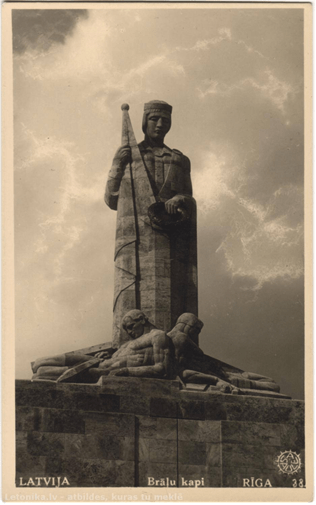
The Mother Latvia. The central part of the Brothers
Cemetery that holds the graves of the Latvian soldiers who fought in the independence war
The war freedom has become legendary time for Latvian history. Movies such “Lachplesis” (1930), “The Guards of Riga” (2008) and the “Blizzard of Souls” (2019) is part of making this legend. The fallen heroes of the war of Freedom are laid to rest in Brothers Cemetery in Riga and other parts of Latvia. Surviving soldiers were awarded with the Order of Lachplesis. The war for freedom is to be remembered for every Latvian in the future.
Selected Sources:
Pētersone, Inga. (Ed) (1999) Latvijas Brīvības cīņas, 1918-1920 : enciklopēdija. Riga: Preses Nams.
Bērziņš, Valdis. (2000) 20. gadsimta Latvijas vēsture. I, Latvija no gadsimta sākuma līdz neatkarības pasludināšanai, 1900-1918. Riga: Latvijas vēstures institūta apgāds.
Lācis, Visvaldis (2001) Latviešu zemes un tautas vēsture. Rīga : ASF Saules koks : Vieda.
Bleiere, Daina, Butulis, Ilgvars, Stranga, Aivars, Feldmanis, Inesis and Zunda, Antonijs. (2006) History of Latvia : the 20th century. Riga: Jumava.
 Latvian History
Leave a comment