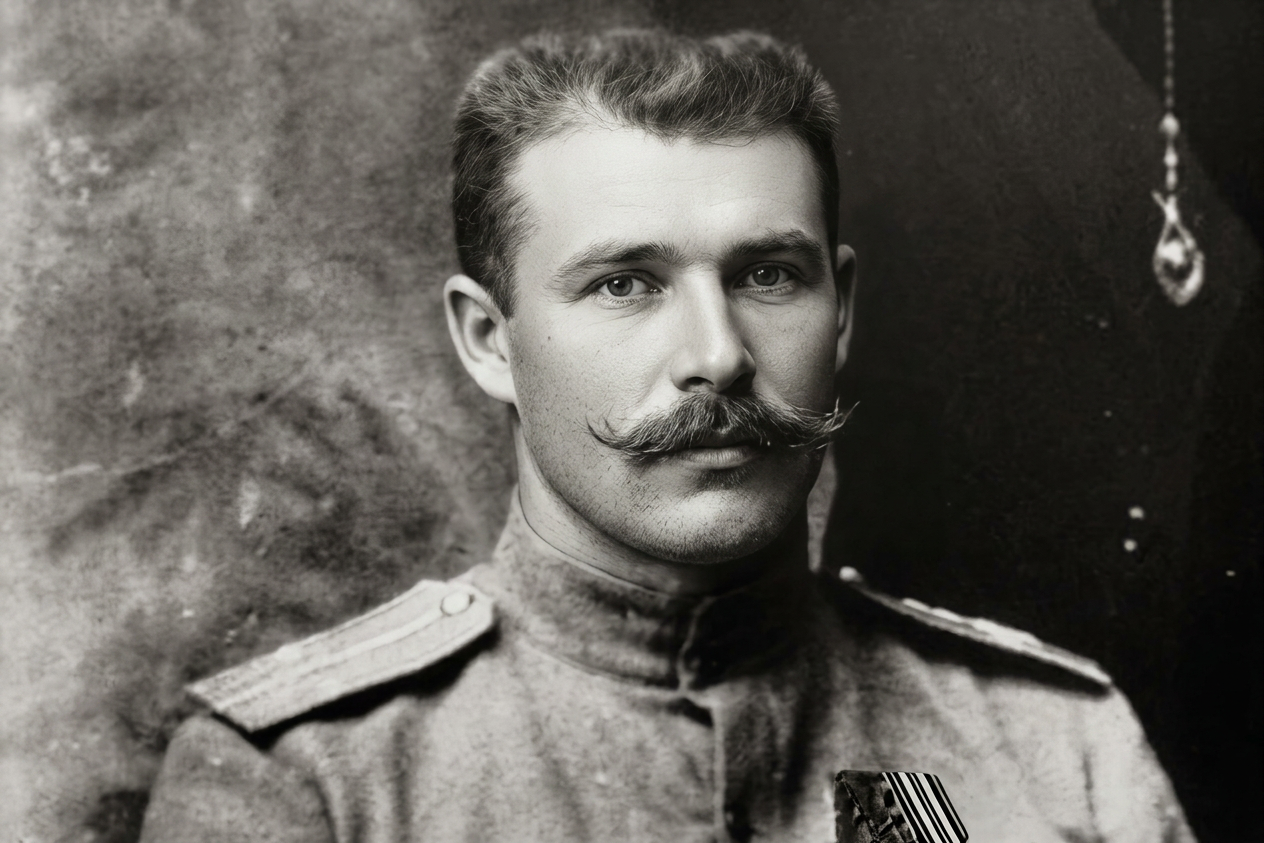
Lieutenant-General Oskars Kalpaks – the first commander in chief of the Latvian armed forces. AI Enhanced picture
No country cannot exist without its armed forces. There are a few exceptions with fully sovereign countries without any official national armed forces, but even the smallest nations have their own armies. The Republic of Latvia was born in combat. With great difficulty the national Latvian government managed to form their own armed forces. The Latvian Army fought the Bolsheviks and Germans and secured the Latvian independence. During the first twenty years, the Latvian Army became a disciplined and venerable force. However, in 1939 -1940 Latvian Army was unable to defend their country against Soviet occupation. It was partly do the completely disadvantageous military situation and mistakes done by Latvian rulers. This article tells the story about Latvian army during the years of independence.
When on November 18 1918 the Republic of Latvia was proclaimed it had no armed force. On November 17 a Latvian Peoples Militia was formed. Latvia was still under German military control and the Bolshevik invasion was looming. One of the first national armed units was the Special Student Company formed on November 20 1918. It was formed from University students and members of the student fraternities. They were stationed at Brīvības Boulevard 32 where later for long years the Faculty of History and Philosophy was located. Many smaller units were made with the help of the Latvian National Rifleman Union.
The first largest Latvian armed unit was formed on January 5 1919. The Special Latvian battalion later brigade was commanded by lieutenant colonel Oskars Kalpaks. He became the first supreme commander of the Latvian army. Sadly he was killed in accidental fire exchange with allied German forces on March 6 1919. He was replaced by colonel Jānis Balodis. The second largest Latvian armed force was the North Latvia brigade commanded by colonel Jorģis Zemitāns. The brigade was formed with Estonian help. The Latvian army baptized in fire in battles against German Iron Division at Cēsis, Bermont army at Rīga and against the Soviets in Latgalia. On 1920 52 000 soldiers took part in Latvian army. The official birthday of the Latvian army is considered July 10 1919, when two largest Latvian armed units the North Latvian brigade and the South Latvian brigade joined ranks under the command of general Dāvis Sīmansons.
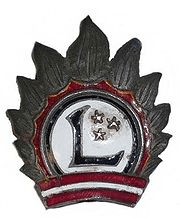
The Latvian Army Cockade 1919
After the peace agreement with Soviet Russia, the army moved to a state of peace. The planned size of the Latvian peacetime army was planned 240 00 men, but the real count was much smaller. The army was formed in four divisions – Courland, Vidzeme, Latglian and Semigallian with three infantry and artillery regiments in each. The regiments were numbered and named after largest Latvian cities: 1 Liepaja, 2 Ventspils, 3 Jelgava, 4 Valmiera, 5 Cēsis, 6 Riga, 7 Sigulda,8 Daugavpils, 9 Rezekne, 10 Aizpute, 11 Dobele, and 12 Bauska infantry regiment. The technical units were united in the Technical division. It was based on Auto tank division, Field Engineer Division, Aviation Division, Electro technical division, Armed train division, Heavy Artillery Division, Coastal Artillery Division and Anti-air artillery division. In 1939 the Aviation division was formed of three fighter squadrons, four mainland and one fleet reconnaissance squadron. Latvians had 100-150 planes, but most of them outdated. The most modern aircraft in the army where the British biplane fighters “Gloster Gladiator”. Latvian army command planned to upgrade their air force and started talks with British to purchase “Spitfire” fighters. However, the outbreak of WWII halted this.
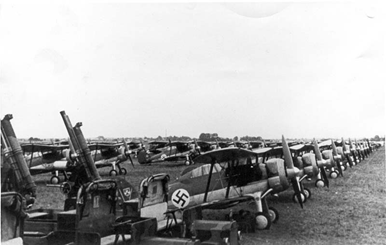
The Latvian Air Force Gloster Gladiator fighter planes
The whole Semigallian division and Cavalry regiment was stationed in Daugavpils. Latgalian division in Alūksne, Cēsis, Valmiera and Rēzekne. Courland division was stationed at Liepaja.
The Latvian War Fleet was located in Liepaja, the home of ex Russian Baltic Imperial Fleet. Latvian flagship was “Virsaitis”. Latvia had two submarines “Ronis” and “Spīdola”. Two minesweepers “Imanta” and “Viesturs”.
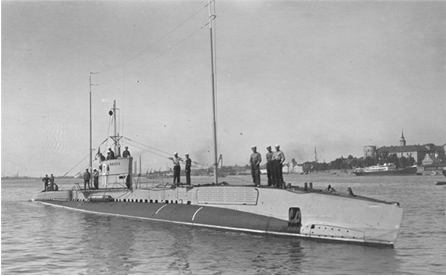
Latvian submarine “Ronis”
The Vidzeme division along with Technical division was placed in Riga. According to data in 1 January 1939, Latvian Army had 1969 officers, 3988 service instructors, 11 118 soldiers, and 1244 contract workers. Together 18 389 men. Latvia Army also included Latvian Guard (Aizsargs) organization a paramilitary force that was formed during the War for Freedom. It was under control of the Ministry of Interior, from 1937 under Social affairs ministry. Aizsargi was an auxiliary force that maintained civil order in the countryside. They were formed in 19 territorial regiments and had its own aircraft and armed trains.
The most prestigious Latvian armed unit or special guard was the Army Staff Company. Only specially chosen men could serve in it. The requirements were personal height no less than 1,80 meters, the shoe size no less than number 43. Health had to perfect and also recommendation from local authorities were needed. Their tasks were to represent the state in national celebrations or during official foreign visits. The Army Staff Company was entrusted with defending the main national objects – Presidential palace and the House of Ministers. Also their most honorable task was the guard of honor of the Monument of Freedom. The Army Staff Company was restored after the regain of independence and is doing the same tasks.
According to the Latvian constitution (Satversme) the supreme commander in chief was the President of Latvia. The army and war fleet was ruled by the War Ministry. The orders and directions were fulfilled by the Army Staff. Latvia had military draft. The time of service was 18 months after 1931 12 months for infantry and 15 months for the rest of the army men.
According to data sent to the League of Nations, on 1 June 1940, Latvia had 2013 officers, medical officers and administrative officers. 27 555 officer deputies, instructors and soldiers in all 29 569 men.
On June 17 1940 Soviet tanks crossed the Latvian border and occupied Latvia. Latvian army was ready to resist the aggression, but was told not to resist. With a Soviet garrison in Courland already stationed according to the Mutual agreement signed in 1939 it was already too late to resist the enemy. As the armies of Estonia and Lithuania also decided not to resist the independence was lost. If there ever was any chance of resistance it had to happen in 1939 by declining the Soviet demands for mutual assistance pact. As in the case of Finland such move would cause Soviet invasion, and only joint resistance by three Baltic States would make any difference. Latvian army was subjected to Soviet repressions and its leadership was destroyed. Latvian army was included in Red Army 24th Territorial Corpus that was nearly destroyed in 1941. The trauma of inability to resist the Soviet occupation later resulted in support for forming the Latvian Waffen SS Legion.
Latvian Army was reborn in 1991 after the regaining of independence. Today Latvian armies may seem much smaller than before, but it’s a member of NATO and taken part in international operations. The ideals of the War for Freedom and the Latvian army are the prime motivation for Latvian National Armed forces.
United Sources:
Andersons, Edgars. (1992) Latvijas bruņotie spēki un to priekšvēsture. Armed Forces of Latvia and their historical background. Riga: SIA “S un S’.
Ciganovs, Juris. (2001). Latvijas Armija 1918-1940 = Latvian Army 1918-1940. In Latvijas Nacionālie Bruņotie Spēki – 10 = Latvian National Armed Forces, p 11-22. Riga: Latvijas Republikas Aizsardzības min.
 Latvian History
Leave a comment