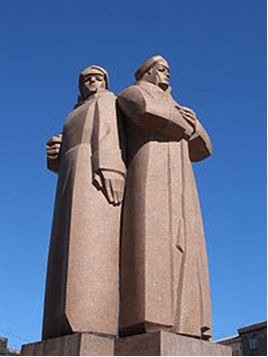
The Monument of the Red Latvian Riflemen
The formation of the Latvian Riflemen regiments had national causes. Latvian land was invaded by the German army, and large numbers of Latvians applied to make national armed forces in the Russian army. The Tsar Nicholas II had doubts about that – he remembered the revolution of 1905 where Latvians took an active role. After three years of war his fears became true – Latvian riflemen joined the Bolshevik revolution. A Latvian red riflemen are one of the controversial subjects in Latvian history. Praised by Lenin, doomed by Stalin and hated by nationalist Latvians, Latvian riflemen had made their place in Russian history. Their role in the Russian Civil war are often overestimated and filled with many myths. Only in last twenty years we are able to discover who these men really were.
As mentioned the Latvian riflemen regiments were originally formed in 1915 to defend Riga from the Germans and liberate the rest of the Latvian land. Latvian riflemen fought in heavy frontline for two years. On the outcome, Germans could not capture Riga, but Russian army also was unable to chase the Germans away. Latvian riflemen suffered heavy losses in the battles of Island of Death (1916) and the Christmas Battles (1917). Latvians were angered by the incompetence and hypocrisy of the Russian high command. Also supporting the Russian divisions were not much of a help.
On February 23-27 (8-12 March) Tsar Nicolay II resigned. Russia was now ruled both by Provisional government and by the Petrograd Soviet. The two government situation led to confusion and rivalry. The armed forces now became the center of the political fight arena.
The Interim government was ready to continue the war, while the Bolsheviks promised peace and bread. The leadership of 12th army where Latvians fought tried to establish loyal executive committee called Iskosol. However, Latvians had no interest about it. On March 26 representatives of the riflemen first met at Valmiera and decided that they must continue to fight and support the Petrograd Soviet. They also asked for autonomous Latvia in democratic Russia. Soon the riflemen circles were entered by the Bolshevik agitators. From 9 to 11 April in Riga 1st riflemen congress took place deciding to organize united officer and soldier executive committee or Iskolatstrel.
The Iskolatstrel was ruled by far left wing majority, however there were calls for Latvian national autonomy. The leading figure was staff captain Ozols. Despite the presence of right wing views among Latvians, the Bolsheviks started to gain the upper hand. They were superbly organized and experienced. Their sympathizers were mainly low rank soldiers, while officers were more nationally minded. Also there so called Mensheviks that fell out with the Bolsheviks and asked to support the Provisional Government. On May 29 at the Second riflemen congress conducted a resolution that disapproved the Provisional government and asked the handover of power to the workers, soldiers and peasants.
In spring 1917 the German general staff decided to finally capture Riga and encircle the 12th army. The attack was set at September 1 and the Russians were aware of this. However, the army was demoralized and could not withstand the German cannonade and fell back. However, Latvian riflemen continued to resist faced Germans at Mazā Jugla. Facing German majority, Latvian riflemen held of the offensive rescuing the Russian army units who retreated in panic. Even despite Bolshevik sentiments the Latvian riflemen were ready to defend their homeland. In same time loyal to Russian government units fled without a fight. Latvians managed to hold for 26 hours and then retreated with the rest of the 12th army. The army was saved but Riga was lost.
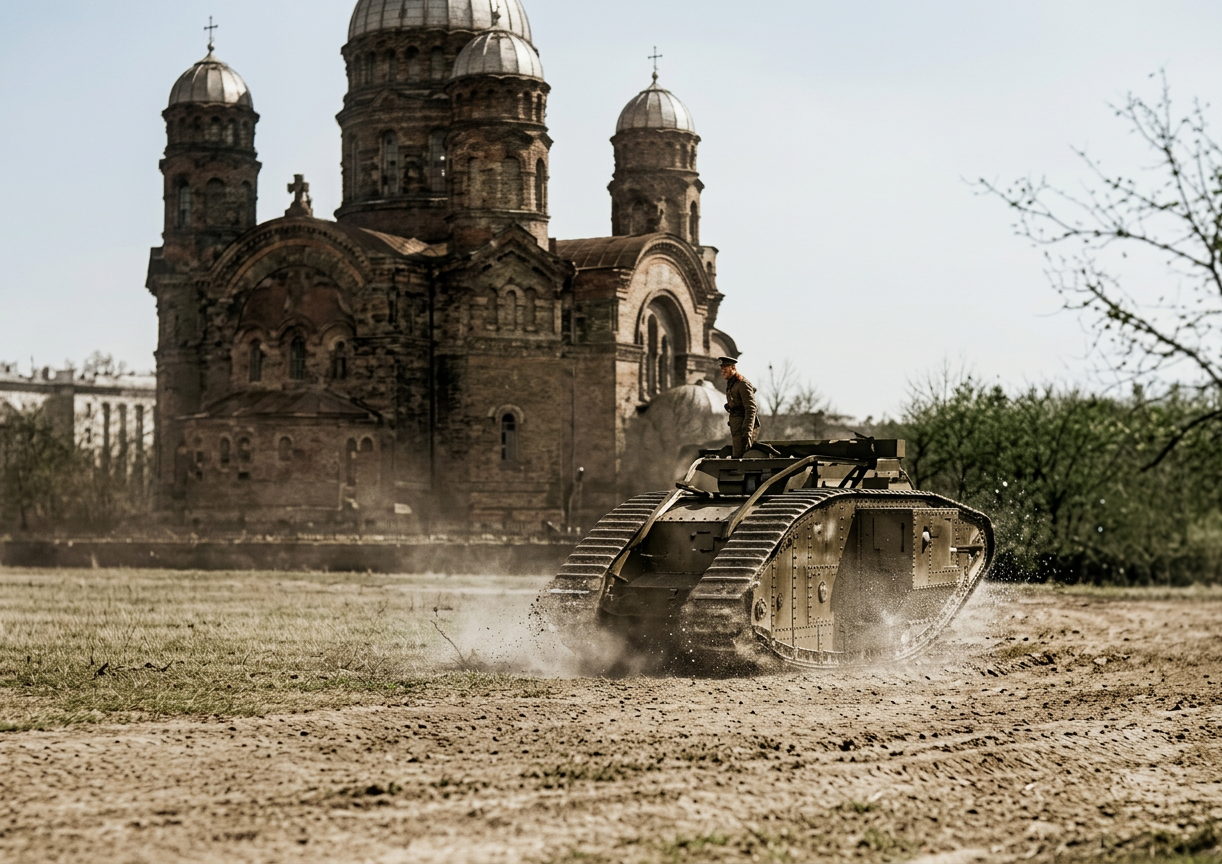
German tank entering Riga in 1917. AI enhanced image
Meanwhile in Petrograd (Petersburg) the Provisional government started to lose its power. The Bolshevik uprising in July and Kornilov Affair in August made Lenin strongest.
When the 12th army was in disarray on October 25 (7-8 November) Bolsheviks seized the power by coup and called it an international revolution. The majority of the Latvian riflemen supported this. Only a small circle of Latvian officers and nationally minded soldiers gathered in the Latvian National Soldiers Union. The Iskolatstrel lead by Bolsheviks turned down the right wing Latvian National Provisional Council.
For a short time a Soviet power was established in Latgalia and much of Vidzeme. Meanwhile in Petrograd it was decided that Red Guards and Sailors are not enough to defend the city. So first Latvian riflemen 6th Tukums regiment was sent to defend the Bolshevik headquarters in Smolny Institute. Many Latvians were against this. The new arrived Latvians took part in disbanding the Constituent Assembly January 19 1918.
Lenin could not legitimize his seizure of power. The Russian army had collapsed and the new Red Guards were poorly disciplined. So Latvian riflemen who still kept relative unity and discipline were summoned to help the Bolshevik revolution. A Latvian revolutionary corpus was made. On February 19 1918 Germans launched a full scale attack to capture all parts of Latvia and Estonia. Latvians retreated this time. On March Latvia riflemen marched in Moscow. Russia was already full of Latvian refugees from WWII. Latvian riflemen were forced to abandon their homeland, but their will was still strong and hopes of returning were high.
On March 3 Soviet Russia signed peace agreement with Germany. The Russian military command was reorganized; all high command posts were disbanded and staffs were fired. It turned out that of destroyed multi-million Tsarist army only Latvian riflemen was left intact. At Moscow 5700, at Petrograd, Toroshin and Bologoje – 6000 Latvian man still were ready to fight. Initially an order came to disband the Latvian regiments; however with the lead of commander Jukums Vācietis the order was disputed. While the Soviets officially declared that they have an international army, they were forced to include national division in their ranks. Latvians had a great reputation and still ready to fight. Also Estonian divisions in the Red Army were formed.
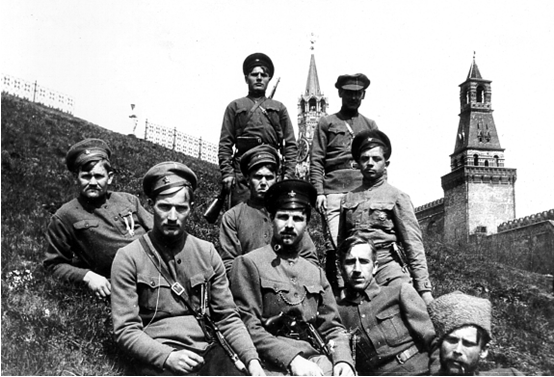
Latvian Red Riflemen in Moscow
On April 13 1918 the Soviet Wartime and people’s commissariat issued an order to form Latvian Soviet riflemen divisions. The commander in charge was Vācietis, and commissars were Pētersons and Dozīte. It was one of the first divisions in the Red Army. Nearly all remaining Latvian men joined, all believed in the coming defeat of Germany and the liberation of Latvia. Most of them took the riflemen regiment as their family and had nowhere to go since the border was closed. At the end of 1918 there were 23-24 thousand man in the division along with 400 machine guns, 80 cannons and 20 airplanes.
One of the first serious Latvian battles in the Russian civil war was the uprising of the Czech legion May 1918. The legion of Czech and Slovak nationals was formed from prisoners of war and included in the Russian army. Soviets initially promised to transport them over Vladivostok to France. However, Soviet war commissar Leon Trotsky ordered to disarm them. A legion of size of 51 000 men revolted and took over large areas from the Volga to Far East. After a first incidental encounter between Latvians and Czechs, that proved successful for Latvians, more regiments were sent to deal with the enemy.
On July 6 in Moscow the anti-Soviet leftist movement the Socialist Revolutionary Party of so called Esers, launched a coup against the Soviet government. Latvians took the most important part in defeating the Eser uprising that crushed this important movement completely. Latvians also crushed the Esers at Yaroslavl, where the ex Latvian riflemen officer Kārlis Goppers was one of the anti-Soviet leaders. Also another Latvian officer Fridrihs Briedis was arrested by Cheka.
As the situation on the Eastern front was critical Latvian officer Vācietis was appointed as the commander in chief of the whole Red Army. At night between 16 and 17 July Soviets murdered the whole family of Tsar Nicholas II. It has been speculated for many years that Latvians took part in the murder. While Latvian historians drastically denies that any Latvian took part in the shooting, Russian historians name at least one Latvian named Celms and claims that five other Latvians refused to fire at the Tsar’s children.
Latvians took the most part in defending the Kazan. On September British Secret service agent’s ambassador R. H. Bruce Lockhart and Sidney Rielly were provoked by Latvian riflemen in a plot to depose the Soviet government. The British believed that the Latvian riflemen will help them to stage a coup, however it was a trap by the Cheka and the ambassador was arrested.
Latvians were sent to the Southern front to face the Don Cossacks. Latvians remembered the actions done by Cossacks in Latvia in 1905-1907. However in November 11 1918 Germany surrendered ending the WWI. On November 13 Soviet Russia annulled the Brest-Litovsk peace treaty. Latvians were ready to go back to the homeland and make it as a Soviet republic. On November 18 in Riga the right wing Peoples Council proclaimed the Republic of Latvia as a national independent state. Soviets saw this as an obstacle. On November 23 the Commissar in the National issues Joseph Stalin ordered to form a provisional soviet Latvian government. That was done in December 4 Soviets needed the puppet republics to justify the occupation of the Baltic States.
In November Red Army Pskov division entered Latvia. Latvians were still far behind caught up in other sectors of the whole civil war front. Latvian riflemen were told that the democratic Latvian provisional government is actually ruled by German barons and the whole idea of sovereign Latvia is just a German trick to annex Latvia. Latvian government was forced to cooperate with the Germans and ask for their armed assistance. However, both sides knew that was a temporary union dictated by the Soviet offensive. Latvian government issued a call to Latvian riflemen to join the ranks of the new Latvian army. Riflemen never heard this and it would not change much. On December 18 first red riflemen entered Latvia.
While the Latvian government had issues forming their own army, red riflemen defeated Germans at Inčukalns. On January 3 1919 red riflemen brought Soviet power to Riga. A Latvian Soviet Army was formed with Vācietis in charge. The head of the Latvian Soviet government was Pēteris Stučka. The Latvian army along with the Germans were chased away to Courland and held a small strip of land from Ventspils to Liepāja.
However, soon the troubling news came from Estonia. Estonian army had defeated the Red Army and head into Northern Latvia. Red riflemen were sent to face the Estonians but were beaten. Estonians had effectively defeated the red riflemen along Valka.
The Soviet plans for communist revolution in Germany crumbled. The Latvian Soviet government carried out nationalization angering the peasants who at first believed that the Soviets will give them land. Soviets issued a mobilization and gathered a force of 250 000 men – young, untrained without any will to fight. Red riflemen in the end managed to stop Estonians from taking all of Vidzeme. Meanwhile Germany sent a large force of auxiliary forces of the so called “Iron Divison”.
Germans along with Latvians started the offensive on February. Soviets were defeated on all fronts also Estonians continued to attack at northern Latvia. In April Estonians formed the 1th Valmiera infantry regiment made of Latvians, many of them deserters from the Soviet army. The mobilized Latvians refused to fight and joined the Estonian ranks. Latvian Soviet republic crumbled. On May 22 Germans captured Riga. The Latvian army followed behind but met their fellow Latvians in the battlefield of Kaugurciems. Soviets were chased away from Vidzeme and retreated in Latgalia. After Germans and Latvians turned against each other in the battle of Cesis, the situation stabilized. Meanwhile Moscow was unsatisfied with the red riflemen and renamed the Latvian Soviet Riflemen division to 53rd Riflemen Division removing its national status. At last a communist fraction was made within the division to suppress any anti-Soviet activity.
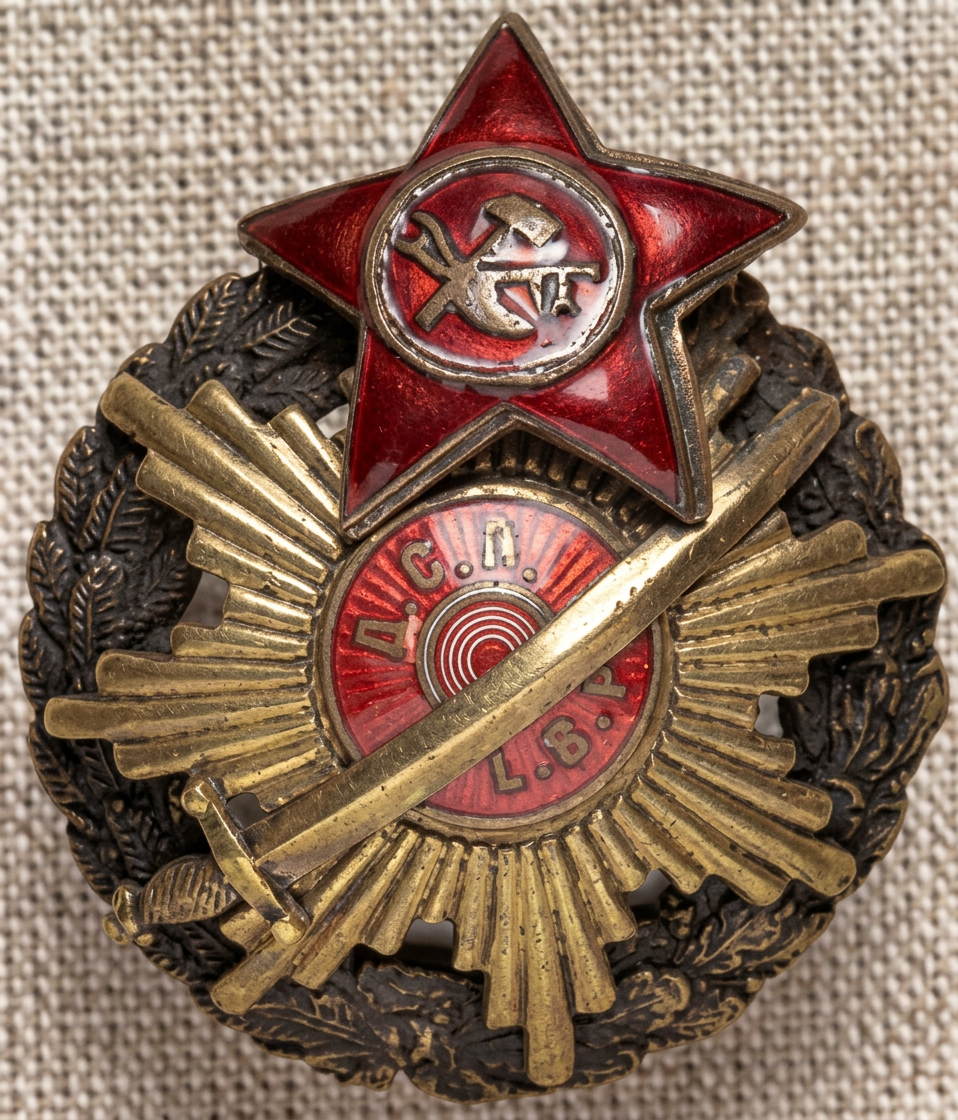
The Insignia badge of the Red Riflemen. AI enhanced image
On July red riflemen were sent to the Belorussian front to fight Lithuanians and Poles. Disappointed Latvian riflemen left their homeland for the last time. In September they were sent to fight of White Guard offensive to Moscow. Latvians now fought on the fields of Orla and Kursk. After finishing Denikin Latvians were sent against Yudenich at Tula region. While other Red Guards run off from approaching White Guard tanks, Latvians did not lose courage and stood against them. Latvian riflemen entered Eastern Ukraine and encountered Anarchists lead by Nestor Makhno.
Meanwhile in Latvia at the winter months Latvian army liberated Latgalia. On 1920 news came to faraway riflemen about peace talks between the Latvian Republic and the Soviet Russia. It now came to Latvian riflemen that their cause for free Latvia was lost and those who they stood against were the real heroes.
Despite that the remaining Latvian forces fought battles in Crimea. After a year of hard battles the remaining Latvian riflemen divisions were finally disbanded. Large numbers of Latvian riflemen choose to move to independent Latvia. Others however stayed. Many of them like Vācietis, Bērziņš, Pētersons and others stayed in Soviet Russia and took high governmental posts. During the purges of 1937-1938 the remaining elite of the Latvian riflemen was eliminated. Soviet leadership disliked the Latvian riflemen from the start, but was forced to relay on them.
Stalin destroyed most of the top Latvian red riflemen. After the occupation of Latvia, the Soviet propaganda remembered about them and used to justify the Soviet power. A monument commemorating them was placed in the center of Old Riga. A museum dedicated to them was built nearby which now serves as a museum of occupation.
The reason why the Latvian Red Riflemen is sometimes called the core of the Red Army and the rescuers of communist revolution was their great discipline and will power. The Red Army units were often unorganized and cowardly. The Soviet commanders lacked talent. So the Soviet leadership sent Latvians to the most troublesome spots on the front where other Red Army units could not handle. The main dream of the Latvian riflemen was to liberate Latvia from the Germans. The fate made to fight for the Soviets that did not want any independent Latvia. Undoubtedly many really believed the Soviet propaganda, but seeing how many left Russia for Latvia in disappointment shows that real ideal for them was their fatherland. Latvians did take part in many Soviet atrocities, however in overall Latvians were one of the most disciplined in the Red Army. The fate of the Latvian Red riflemen is one of the greatest tragedies of the Latvian nation. 20 years later Latvians again were forced to fight in the Soviet ranks where they met their Latvian brothers in Nazi ranks. Latvians must never again fight in the ranks of the totalitarian armies. The main army in Latvia is our National Armed Forces that are a pride of our nation.
Selected Sources:
Bērziņš, Valdis. (1995) Latviešu strēlnieki : drāma un traģēdija. Riga: Latvijas Vēstures institūta apgāds.
Pipes, Richard. (1991) The Russian Revolution. New York : Vintage Books.
Pētersone, Inga. (1999) Latvijas Brīvības cīņas, 1918-1920 : enciklopēdija. Riga: Preses Nams.


Leave a Reply