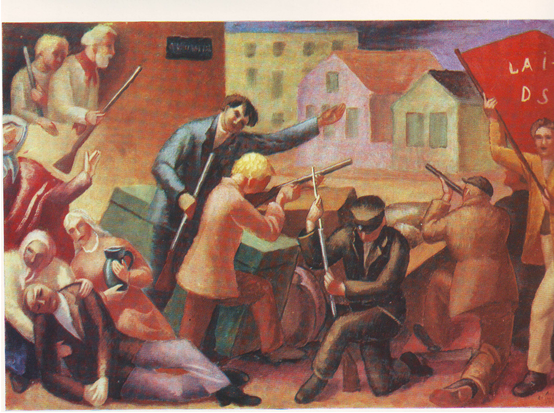
The Barricades of 1905. Painting by Ansis Cīrulis
The 1905 revolution in Russia is mostly known for its Bloody Sunday and the Battleship Potemkin and the Jewish pogroms. But in Latvia, then part of the Russian Baltic provinces the revolution of 1905 was a wakeup call and the beginning of social and national liberation. The revolution took place on the streets of the cities, rural areas and forests. Latvian revolutionaries fought Tsarist police and Baltic German landlords. Not only that, the fire of the revolution lighted up in Helsinki and London as the actions of the Latvian revolutionaries reached international level. There are many aspects of this revolution that need separate chapters. This is a concise survey of the 1905 revolution that took place in Latvia.
In Russia the causes of the revolution was the great social inequality, the defeat in the Russo-Japanese wars, national divide and authoritarian government by Tsar Nicolay II. For Latvia, one of the main reasons was the national inequality between Latvians, Jews and the Baltic Germans. Despite many Latvians enjoying relative freedom for education and career, the overall situation was still against them. In rural areas Latvian peasants were still fed up with the Baltic German landlords, from whom they had to rent their lands and work for them. The movement by intellectual Latvians faced many restrictions. Latvian press was censured; the rights for political activities were stripped down and the use of Latvian language was limited in public places. Latvians faced double oppression from Baltic German elite and Russian administration. Also Jews and Poles in many cases felt the same oppression. Latvians were also no strangers to war with Japan; many Latvians were sent to frontlines and the Russian navy that was destroyed in Tsushima, originally left from the port of Liepāja.
However, the main movement for revolution was not the nationalists, but social democrats who aspired from the teachings of Marx. At the end of the 19th century the New Latvian movement had lost it’s original power for it could not answer the new emerging problems caused by industrialization. The New Latvians were mainly middle class intellectuals, descendants of the Latvian farmer families. Their main strives were education, making their own business and national conservation. The rising working class needed different answers and many found them in internationalist social democracy. The main pushers of this new kind of thinking were The New Current movement that expressed their views in the newspaper “Daily Sheet”. The main person behind the paper was the new student Jānis Pleikšāns who called himself Rainis. He and his colleagues took the ideas of social democracy from Germany where there was already an official Social Democrat party. Their ideology was internationalist and was based mainly on the working class of whom only 5,6% were Latvians. While they certainly talked about the rights of the Latvian landless peasants and Latvian education, their cosmopolitism did not go along well with Russification policies that weakened the Latvian national strength. The Latvian social democrat slogan was: “The worker has no fatherland!”
In 1897 in Vilnius the Jewish social democrats founded the General Labor Bund party. In 1898 the Russian Social Democratic party was born. Latvian Social Democrats became more and more inspired by their Russian and Jewish colleagues. In 1899 Russian Authorities closed down the “Daily Sheet” newspaper and forced Rainis and his colleagues to exile.
The one of the first Latvian political movements emerged in 1903 in Switzerland. Latvian exiles founded the Latvian Social Democratic Union. Their first congress took place in Riga on December 29-30 1905. The party did not last long and was outmatched by Latvian Social Democratic Workers Party that was founded in 1904. There was a great difference between these two parties: the LSDU was more national oriented while LSDWP was overall internationalist. Their main leaders were Miķelis Valters, Ernsts Rolavs and Kārlis Skalbe. Their political platform was full rights of self-determination, the formation of the Latvian parliament, and in case of a break up of Russian empire – the formation of independent Latvian state. The LSDWP did not believe in full independence, but fought for free Latvia in united free Russia. As their colleagues in Russia they desired to overthrow the tsarist regime and then establish autonomous social democratic Latvia. In the end the LSDWP was the main force behind the 1905 revolution.
The start of the 1905 revolution in Latvia is considered the January 13 (January 26 according to Western calendar) when in Riga a large crowd of people marched along the Moscow Street in the city center. A day before a general strike was called in Riga and other cities. The action was inspired by the bloody events in Petersburg in January 10 (23). The crowd singing revolutionary songs and waving red flags were stopped by a junior officer squad at the Iron Bridge near river Daugava. As the protestors tried to break trough the soldiers opened fire killing 73 protesters and injuring 200. Strikes and demonstrations took place in all Latvian major cities.
The general strike was one of the biggest in whole Russia. However, after winter passed the fires of revolution reached the countryside. Thousands of landless peasants were united by the revolutionary ideas of equal rights and mainly the free land for all. Land workers started strikes against German landlords. Demonstrations waving red flags took place near churches sometimes protesters invaded the church mess and held revolutionary gatherings. Such sights were not common in Latgalia where Catholic and Orthodox churches were respected. The Lutheran church was associated with the Baltic Germans.
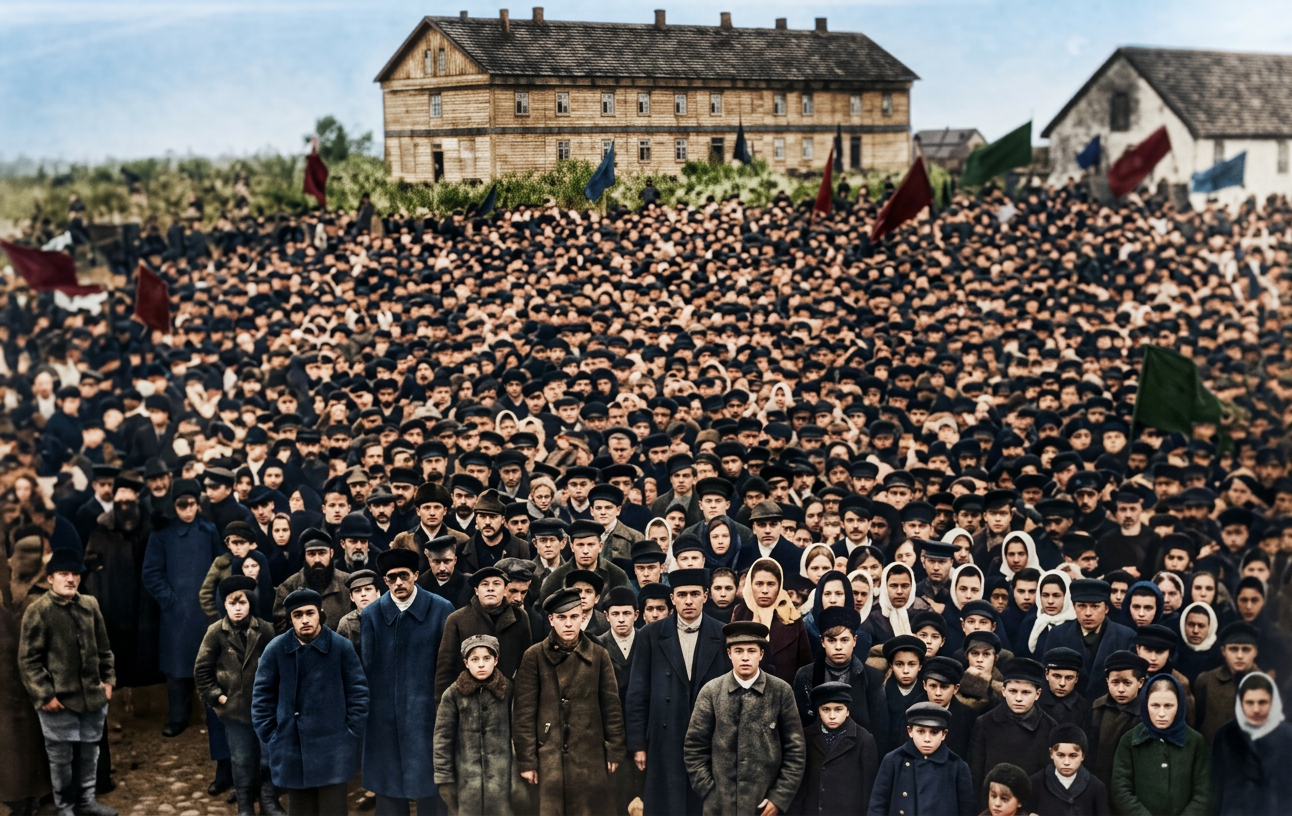
Peasant demonstration in Dundaga on 1905. AI enchantment of the original photograph. Its considered by some scholars the original black and white picture was a photo montage.
On June 15 (28) almost at the same time when the mutiny on battleship “Potemkin” took place, the Russian sailors at Liepaja took arms. The reason was the same as in case of “Potemkin” – maggots in the meat. Sailors took over the guardhouse and forced commanding officers to flee. However, on June 17-18 (30-1) June reinforcements came from Riga and disarmed the sailors. 138 men were taken to war tribunal.
When Baltic Germans started to take arms to protect themselves, the blood spilled on the countryside. In Sesava church two barons opened fire against people calling “Down with the Tsar!” And in return Latvians killed one of them injuring the other one. Baltic Germans asked for help from Russian army. Russia sent ruthless Cossacks, Germans themselves formed self-defense squads. Latvian peasants attacked the German mansions, took away their arms and money.
In August LSDWP formed fight groups. In Riga 1000 men joined the ranks. On the night of September 6 -7 (19-20 Sept) a group of 52 men raided the Riga Central prison rescuing two of their comrades Lācis and Slešers. In this daring raid few Jews from Bund also helped their Latvian comrades. Latvian Jews took active part in the revolution. While in other places in Russia bloody Jewish pogroms took place, there was a relative unity between Latvian and Jews. Instead on October 22-23 Latvian social democrats helped to stop rioting in the Riga Moscow district that could turn in Jewish pogrom. The main leader of the Latvian Jewish revolutionary movement was Simon Nachimson.
On October 12-13 (25-26) General Strike in whole Russian empire took place. Latvians also took place in it. Tsar Nicolay II was forced to issue an “October manifesto” where he promised to give people freedom of speech and meeting. Also a freely elected State Duma parliament was promised. Latvians met this with great joy and gathered in many demonstrations. At the Grīziņkalns Park in Riga 80 -100 thousand people gathered to celebrate “freedom”. However, there were bloodsheds between loyalists and revolutionists. At countryside locals abolished local Czarist municipalities and elected their own people. The October Manifesto did not ease the situation but heated up it as people were asking for more. In the end Tsar was forced to use armed force and break up the revolt.
At November great battles erupted in Courland. For a short time Russian authorities only controlled Liepaja and Jelgava. A large bloody battle took place in the city of Tukums. Latvian militia managed to chase away the dragoon squad and infantry. Then Russian forces tried to recapture the city, Tukums was bombarded by cannons. Revolutionaries were forced to retreat. The Russians suffered great casualties. Similar events followed in the town of Talsi. The last bloodiest battle took place at Aizpute on December 16 (29). Revolutionaries lost 100 men.
On January 17 (30) 1906 14 revolutionaries raided the Riga Secret Police headquarters. The aim was to rescue LSDWP Central Committee member Jānis Luters ‘Bobis’ and Pēteris Liepa. The Secret Police building was located on Aspazijas Boulevard in the city center. The building was guarded by 160 soldiers and there were more on the city streets. 14 men managed to slip through the heavily guarded streets and invade the secret police building by surprise. Six men with them Jānis Luters ‘Bobis’ and Teodors Kalniņš were rescued. Police men fled the scene, but 160 Russian soldiers barricaded in their rooms.
Situation in Latvia was so extreme that the Russian authorities decided to send reinforcements. On December 12 1905 a state of war was issued. The Russian punishment corpus lead by general Orlov entered Latvia to completely suppress the revolution. On the morning of December 20 revolutionaries raided the rubber factory Provodnik where 60 Russian dragoons were located. In four minutes 30 revolutionaries killed 17 and injured 20 dragoons.
In the countryside the revolution had gone to extremes. Latvian peasants started to execute the German barons and burn down their mansions. Many architectural wonders like the castle of Stāmeriene were burned to ashes. 449 mansions were burned down. As the Orlov men came the bitter fights and executions erupted all around. The core of the Orlov army were Cossacks from North Caucasus. People were tortured and executed. For the first time some few thousand Latvians were sent to Siberia.
The revolution was completely defeated in 1907. 2041 revolutionaries lost their lives, 7-8 thousand men were imprisoned, 427 were executed and 2652 were sent to Siberia. The fires of the 1905 revolution reached the outside world in the following years. Latvian revolutionaries escaped Russia and continued their fight. Jānis Luters Bobis was the leader of the attack on Helsinki (Helsingfors) bank and also lead the arms smuggling from the West. On February 26 25-30 Latvian fighters invaded the bank owned by the Russian state in the main city center. Their gain was 100 to 150 thousand rubles. Social democrats called the bank robberies- “expropriations”. Joseph Stalin also started his revolutionary career with expropriations. Latvians managed to bring into Latvia a large number of arms, explosives and money.
Some years later in December 1910 a group of Latvian anarchists lead by the Peter the Painter or Peter Piatkow started a wave of attacks on jeweler’s shops in London killing two officers. On January 2, the police became informed about their hiding spot at Sidney Street they blocked the street and started siege. Despite being outnumbered revolutionaries had superior weapons and showed stiff resistance. The Tower of London was called for backup and Home Secretary Winston Churchill arrived. He directed the siege and after six hours of shooting the field artillery strike set the building where Latvians were hiding on fire. Churchill prevented fireman to douse the flames, instead he waited for a Latvian attempt to escape. But, no doors ever opened and instead they found two burned bodies. There was no sign of Peter the Painter however.
The mystery of the Peter the Painter still lies unsolved. There are no clear facts of what happened to him after the Sidney Street siege or what was his real identity. Some historians associate him with later Cheka agent Yakov Peters. British historian Philip Ruff first suggested that Peter the Painter was Latvian painter Gederts Eliass, however in his latest book he points to Latvian far leftist Jānis Žāklis.
The revolution in Russia in 1905 was a peoples and nation’s revolution. Similar national sentiment was present in Estonians, Lithuanians, Caucasians, Poles and Jews. Many Latvian Social Democratic leaders exiled and continued their fight against the Russian tsarist regime. Some became anarchists. While others came to conclusion that international revolution is not the answer and started to fight for full national independence. In 1914 the First World War erupted and in 1915 it came to Latvia. It was the time of next Latvian national awakening – formation of the Latvian national rifleman regiments and the birth of Latvian Republic at the end.
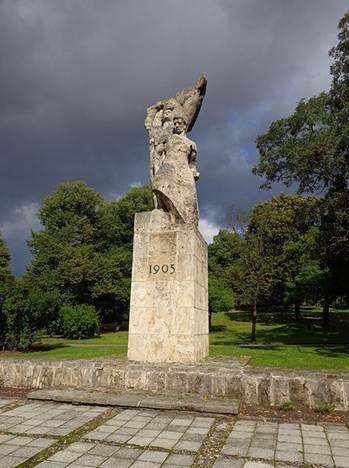
The monument for the 1905 revolution in Riga.
Selected Sources:
Bērzinš, Jānis. (Ed.) (2006) 1905. gads Latvijā: 100 : pētījumi un starptautiskas konferences materiāli, 2005. gada 11.-12. janvāris, Rīga. Riga: Latvijas Vēstures institūta apgāds
Apine, Ilga. (2005) 1905.-1907. gada revolūcija Latvijā un latviešu sociāldemokrāti. Riga: Zelta Grauds.
Lācis, Visvaldis (2001) Latviešu zemes un tautas vēsture. Rīga : ASF Saules koks : Vieda.
Bērziņš, Valdis. (2000) 20. gadsimta Latvijas vēsture. I, Latvija no gadsimta sākuma līdz neatkarības pasludināšanai, 1900-1918. Riga: Latvijas vēstures institūta apgāds.
 Latvian History
Leave a comment