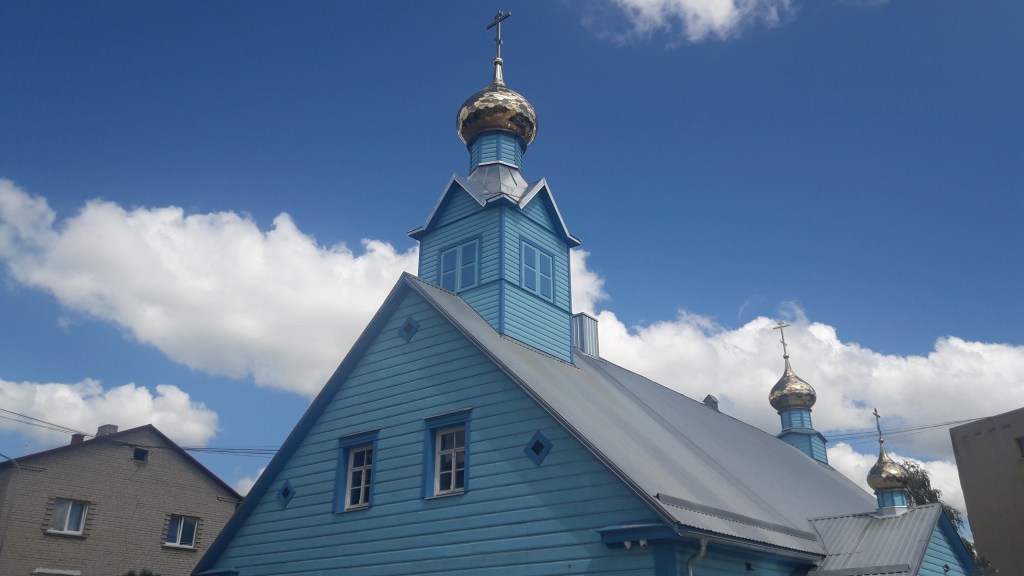
Russians are the largest national minority in Latvia. For centuries their numbers and influence have grown. In 2012 a referendum took place to make a Russian language as the second official language. The majority of the people voted against, however about 25% voted in favor. That is a clear sign that some Russians are willing for ethnic confrontation and show their dissatisfaction with the Latvian state. Why this has happened and what is the history of Russians in Latvia – it will be shown in this chapter.
Russian factor has played its role in Latvia since the Middle Ages. The Russian Duchies – Pskov, Polotsk and Novgorod showed great interest for Latvian territory, because of valuable trade route across the river Daugava. It was the route to Europe for Russians. First Russian inhabitants were merchants that came in the 10th century from 14th to 17th century it was the small size of Russian emigrating peasants, sectarians and insurgents that escaped from Russian rule. The next most important wave was the Old believers of the Orthodox Church in the 17th century. They were the ones who opposed the church reform by patriarch Nicholas and were subdued to repressions.
Already in 13th century Russian tradesmen owned many estates in Riga and had their own quarter within the walls of Old Riga. In 17th century Russian and Polish immigrants and refuges founded the city of Jekabpils (Jakobstadt). By the law of the Duchy of Courland and Semigallia this town was only allowed for Russians, Lithuanians and Poles. An Orthodox monastery was built there. The old believers lived in Latgalia in their own villages by their own traditions. The Russian language as well as German had great effect on the Latvian language.
In 1710 for the first time a part of Latvia was added to the Russian Empire. Before that Russians were immigrants that lived under German, Polish and Swedish rule. Latvian territory was completely annexed by Russia in 1795. In the next decades Russian population rose to second place bellow Latvians. In 18th century 15% Russians lived in Riga. In 1820 there were already 25,9% of them in Riga. 44,5% of Riga inhabitants were Germans and only 15,4% Latvians. In 1897 first main census was carried in Russia. By that census there 151, 2 thousand Russian living in the territory of Latvia. Mainly they lived in Latgalia and the largest cities in Latvia. The rise of the Russian numbers can be explained by industrialization that sent many economical immigrants from Russia. Also Russian army had garrisons in Latvia.
Russians until the middle of the 19th century was not the main elite nation in Latvia. The Tsarist government still relied on the Baltic German elite that took the local governmental posts and set out the legislation. But the Russian Tsars Catherina II (1762-1769) and Alexander II (1855-1881), made reforms that allowed the Russians participate more in local political life. Russians elected their deputies in Riga Municipality.
The Tsar Alexander III (1881-1894) started the Russification policies in all empire. The Russian language became the main legal language in municipal affairs, education system. Russian language became an official language in schools. An assault on Latvian language began as it was strictly regulated in schools. In Latgalia the Latin print was banned for many years.
The revolution of 1905-1907 brought equal rights for Old believers and allowed the organization Russian political movements that local Russians joined. There were Conservative “17. October Union”, liberal Constitutional democratic (cadet) party and National liberal party. The cadets stepped against local Russian privileges and demanded equal rights for all nationalities in Russia. Liberals disliked repressions against Latvian revolutionaries and condemned Russifaction policies against Latvian language. However the conservatives vowed nationalist supremacist slogans for greater rights for Russians. After the collapse of the Russian Empire in 1917, a first national Russian citizen national democratic union (NDS) was founded. The union demanded Russian representation in local governments and rights to use their language. After the proclamation of Latvia, NDS moved to adjust Russians with the new country. In five Latvian parliaments Russians elected their own representatives. However, the Russians were politically divided by many parties that competed with each other. In 1935 there were 10,5% Russians in Latvia however only 2-6% only voted for Russian parties. Many supported Latvian Social Democratic Workers Party. Such political apathy can be explained by large illiteracy and poverty within Russian workers and peasants. The Russian intellectual circles were mainly concerned with politics, but they were detached from Russian low level citizens. The Russian political circles were divided between liberals and nationalists. The liberals owned the main Russian language newspaper “Segodna” (Today) and nationalists spoke out using newspaper “Slovo!” (The Word). There were notable circle of ex White Guard and Monarchist movement in Latvia. They were pursued by Latvian political police and condemned by the Soviet Unio
The Latvian education and citizenship law was more liberal than today. Nearly all Russians were citizens and the Latvian state allowed education autonomy for minorities. Russian schools operated all over Latvia. The Latvian law allowed to get an education in Russian, German and Jewish language. However after the coup by Karlis Ulmanis, restrictions were made against school autonomy to ensure Latvian language education in schools.
The liberal integration policy in Latvia in 1920-1940, can be explained by different ethnic and demographic situation in those times. Latvians were in sizable majority the 77% of the population. There were no large Latvian emigration and the birth rate was positive. Therefore Latvian politicians did not feel any danger to Latvian nation as the minorities were below 10%. However, Latvian government did not allow minorities to form a cultural autonomy that meant self-governing and greater rights for native languages. A much was done to institutionalize Latvian language as the main language in the country. Because the ethnic and demographic situation was completely different the integration policies in those times cannot be realized in the present day Latvia because the situation is much more different.
The occupation of Latvia in 1940 destroyed the local Russian national life. The majority of the Russian political elite were strictly against the Soviet Union. However the lower class workers and peasants were more optimistic about the new Soviet power. It was Russians that were major participants in Railroad station square riots on 17 June when Soviet tanks rolled in Riga, not Jews as often cited. Russians were the main participants in Soviet greeting demonstrations. However, those who opposed the occupation became victims of the Soviet repressions. As the occupation regime established Russian governmental and army workers moved to Latvia.
The Nazi Germany invasion in 1941 brought hope for some Russians that the Nazis will restore national Russian state. A 7 Russian police battalions were made from Latvian Russians, Russians also took part in Latvian Waffen SS legion. However, the most part of Russians hoped for the return of the Soviet rule. Today Russians still have problem to look at the events in 1940-1941 by an objective point of view. Many consider that Latvia was not occupied and the events in 1940-1941 were positive and Latvia joined the Soviet Union willingly.
By 1940 there 207000 Russians in Latvia. In 1989 there were now 90500 Russians in Latvia. The Russian population had rose up to 34% of the all population. This sharp increase was not natural but mechanically achieved by state supported mass immigration. The reasons for this were political and economic. The policy of the Soviet Union was to change the ethnic structure in non-Russian republics by moving people around the whole country. Soviets deported large masses of Latvians to Siberia and forced many to emigrate to the west. In return Soviets boosted up the industrialization in Latvia. The large factories required a large workforce that local Latvian population could not gather, so large masses came from Russia and all other parts of the Soviet Union. Soviet government and local communist authorities did nothing to stop or limit the immigration. Immigrants received apartments without waiting in line and jobs, while Latvians had to wait in lines to acquire apartment and a job in the factory.
Russian immigrants mainly lived in cities. In Riga they became the majority as well in other towns. Only the country side stayed Latvian. Russian language became official and was used in legal papers and education. Although the Latvian language was not generally suppressed the climate made by the authorities allowed Russians not to learn and speak Latvian. However, also Latvians themselves did not put enough pressure on Russians to learn Latvian, like it was done in Estonia. Russian language also served as a tool Russianize Ukrainians, Belarusians, Jews, Poles and other minorities. The members of these nationalities forgot their native tongue and became part of Russian society.
During the movement for regaining Latvian independence Russians split in two sides. Ones supported the independence as the chance for democracy, others fanatically supported the Soviet Union. According to polls in 1989 49% non Latvians supported Latvian independence. That however showed that there were plenty enough of non-Russians who did not support. And the enemies like the Interfront movement were more visible than democratic Russian movements.
After the independence the main question was the new citizenship law. The citizenship law taken effect in 1994 granted citizenship to all residents and their descendants that lived in Latvia before 1940. Those who fell out of this category were mostly immigrants from the former Soviet Union that settled in Latvia after the end of World War II. With this at least the first instance, the residents of Soviet Latvia would not be entitled because there was no legal nexus between the Soviet Union and Latvia.
This made large dissatisfaction by Russians and other Russian speakers who did not gain citizenship. Despite the liberalization of the naturalization process and larger Russian involvement in politics the alienation of Russians from Latvia was clearly visible. However, this was not just the Latvian fault. The Russian Federation policy was to support Russian minority in foreign countries and to use foreign Russians as a geopolitical instrument. By doing so Russia has managed to associate local Russians with Moscow. Russians mainly watch the Russian TV, read only Russian newspapers in live in Russian cultural space separated from Latvian society. Because of this the integration has failed and Latvian politicians have failed to attract the Russian support. All main Russian local political parties and movements are supported and presumably funded by the Kremlin.
According to a census made in 2011 there are 556, 422 Russians in Latvia the 26,9 of the population. The decrease can be explained by the emigration to Russia or to West. Further decrease was found in 2011 census- 557119 people. However, since most Ukrainians, Belarusians, Caucasians and Jews speak in Russian the usage of the Russian language is far greater. They’re still 290, 660 non citizens in Latvia, however the large numbers of them have gained the Russian citizenship instead. That is also part of the Moscow political agenda.
The main reason of the ethnic tension and the referendum is the failed integration policy and some part of the Russian dissatisfaction of the Latvian state. It’s a lie that the ethnic tension is incited only by politicians and there were no real problems. The material for ethnic confrontation was available since the regaining of the independence. The failed Latvian integration policy incited the Latvian nationalists and Russian nationalists on both sides. It’s a myth that petition for Latvian language in schools was the prime cause for the Russian language referendum, it was only a pretext because similar scheme is in action in Ukraine, North Osetia and Belarus. The movement for a referendum would happen even if the wining party Harmony Center would enter government. It was the social and national tension that was present in all time that boosted up the support for the referendum. Also the emergency elections and government making process lighted up the fire.
Ethnic tensions between Russians and Latvians will be visible, as long as they will be boosted by the Kremlin and mistakes of the local politicians. Complete integration into Latvian society is impossible as the integration is an act of personal will, not forced action. Among Latvian Russians, there are many intellectuals, artists and economists that benefit the Latvian society. The goal of the Latvian politicians is to weaken the use of Russia “soft power” and clamp down national radical sentiments to calm both Latvians and Russians. Effective education and social policies are what’s needed to make a national progressive society.
Used Sources
Volkovs, Vladislavs (1996) Krievi Latvijā. Riga : Latvijas ZA Filoz. un sociol. inst.
Фейгмане, Татьяна (2000) Русские в довоенной Латвии : на пути к интеграции. Riga: Sia. Jumi.
Dribins, Leo (Ed.) (2007) Mazākumtautības Latvijā : vēsture un tagadne. Rīga : Latvijas Universitātes Filozofijas un socioloģijas institūts, 2007.


Leave a Reply