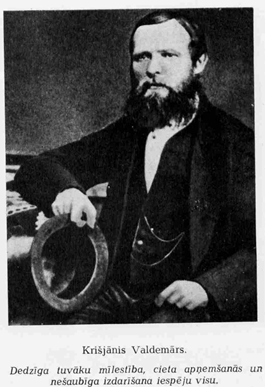
Krišjānis Valdemārs the leader of the Latvian national awakening
Every nation in this world has been formed throughout the centuries. From small groups of tribes with common language roots and traditions into united nation with one language, religion and culture. All large nations The English, Russians, Chinese were united in one nation in a very long time using politics, culture and religion. Latvians have also gone through this process. The only difference from large nations is that the Latvian nation formed under circumstances of foreign rule. And foreign factor had played a large role in the formation of the Latvian nation. However, it’s only up to Latvians themselves to recognize itself as a nation that strives for sovereignty and freedom. Every nation has formed with the help of local national intellectual circles that made to justify the national identity.
Ancient Latvian ancestors were members of Balts a group of people who lived near Baltic Sea. Balts are part of Indo-European language family. Baltic languages show many similarities with the ancient Indian language the Sanskrit. Until 13th Century when German Crusaders arrived the Baltic lands were inhabited by various Baltic tribes. In modern territory of Latvia, four Baltic tribes lived- the Curonians, Semigallians, Selonians and Latgalians. Although they came in contact with Vikings and Russians their pagan culture was untouched and they were mostly on their own. It was because the Vikings and Russians did not have the desire and chances to conquer Baltic lands yet. But German crusaders certainly had.
From 13th century Latvia and Estonia was part of German ruled Livonia. German knights downgraded Ancient Latvians to peasants and removed their rights. It was tyranny by the minority since Germans were in very low numbers. This was a time when Ancient Latvian tribes started to blend in one piece. Important aspect here is Livonian tribe- a part of Finno- Ugrian speakers close to Estonians and Fins. Livonians and Latvians mixed in one piece because of mixed marriages. Because of that Livonians lost their numbers and the language became endangered. Today last remnants of Livonians live on the shores of the Baltic Sea and heading for extinction. However its irrelevant to blame Latvians for this, since Livonians did not hesitate to mix with Latvians and did not do enough to protect their identity. Also a certain foreign factor is blame for Livonian extinction like Soviet imposed militarization of Livonian inhabited lands. But because of this, according to genetic research Latvians hold a large part of the Livonian gene in their genome.
In times of German rule Latvians had the role of peasants, low-level craftsmen without any rights to take part in political matters. Because of that Germans showed little interest in education for Latvians. Latvian language was not in written word nor was special schools open for Latvians. Because of that Latvians received minor information on Christian teachings and kept their pagan folklore and traditions. Throughout the generations Latvians kept their traditional folk songs, symbols, national dress and traditions.
The first books in the Latvian language appeared in 16th century during the Reformation. They were Lutheran catechisms and other religious texts. The Lutheran Catechism published in Latvian in 1588 is the oldest preserved Latvian text. They were written by local German Lutheran missionaries who knew Latvian language and made in print form to convince Latvians to join Lutheranism. The teachings of Luther allowed translating religious texts in the local language not just Latin and that was the starting point of Latvian literal language.
First schools for Latvian pupils were established in the 16th century. The Swedish authorities in Vidzeme allowed to make Latvian lyceums that taught how to read in Latvian. The University of Dorpat was the first university in Latvia and the starting point for the Latvian intellectualism.
It was the intellectual revolution in Western Europe that made local Germans care about the education for their Latvian subjects. The 18th Century was the time of the Enlightenment the movement for educating the masses. Enlightenment helped all European nations to develop and modernize. In this spirit the Bible was translated into Latvian in 1694 by a German clergyman Ernest Glik. And in 1774 a fundamental work by Gothard Friedrich Stender “A book of higher knowledge“was the first scientific encyclopedia in Latvian.
Latvians had gone through many painful and disastrous wars in the Modern Era. The Livonian War and the Great Northern War brought heavy atrocities done by Russian army. The destruction could be compared to Genocide. But those wars did not bring down Latvian will to survive. Latvians did mix with Germans, Swedes, Poles or Russians but despite that kept their ethnic unity.
Until the end of 18th century Latvians were in absolute majority in the territory of Latvia. 89% of the population were Latvians. The Germans were in 6,5% , Jews 1,1%, Poles 0,8% and Russians 0,6%. Despite that Latvians were enslaved by German-Russian politics of serfdom. Serfdom meant that the Latvian peasants who lived in the noble owned land, were viewed as noble’s property, without any right to buy their own land or leave their home. Nobles imposed corvee’s for peasants to maintain and serve their agricultural lands. Very little was left for peasants themselves, in most cases the only pay from the nobles was the food and beer. Any attempts of leaving or disobeying the nobles were punished by heavy fines of by flogging. A majority of Latvians lived in rural areas and worked for the German landlords. The serfdom was the main obstacle for Latvians to become a modern educated nation. Many modern liberal historians are saying the serfdom cannot be compared to slavery. However, the fact that small elite of foreign nobles made the majority of Latvian peasants a lawless subject, who were forced to work for them for the rest of their lives is nothing more than oppression. The fact that Latvians viewed this as oppression is proven by Latvian folk songs condemning the German barons and many Latvian uprisings against them like the Kauguri uprising in 1802. The bloody Kauguri uprising forced Tsarist authorities to make a new peasant law that regulated the amount or corvee’s, banned to sell of buy peasants and established a peasant courts that peasant represantives could take part.
The serfdom was abolished by Russian Tsar Alexander I in 1816-1817 in the Provinces of Courland and Vidzeme. Peasants gained personal freedom, right of movement and local peasant self governing organizations. However peasants were released without land and could not travel around without the permission of the landowner or local authority. The land still belonged to the nobles and the corvee’s remained. Peasants received surnames. They were usually given by local nobles who sometimes gave German or Polish surnames to their peasants. The surname was usually made regarding the peasant profession or the name of his household. Latvians were still stuck with German landlords.
Latvian peasants called this a “bird’s freedom” and in 19th century forties new uprisings occurred in Vidzeme. Russian Orthodox Church promised free land to all who shall convert to Orthodoxy. Many went for this and actually converted. Some people moved to Russia to form new colonies. Tsarist authorities and nobles were forced to make new laws that replaced corvee with paid labor and made peasants rent the land from the nobles. The peasants now could sign a contract with the nobles that allowed them to buy out their farms. It was an important step – a peasant now could become a farmer. The serfdom still continued in Latgalia that was in the Province of Vitebsk where it was only abolished in 1861. Latgalia was ravaged by the Polish uprising of 1863. Russian authorities made a drastic step to ban the use of the Latin alphabet in the press and books. That was a serious drawback for the Latgalian national revival.
The Tsarist reforms of 1860’es weakened the positions of the German nobles and improved the Latvian situation. The nobles lost their rights to punish peasants. Peasant self-governments were improved. However, the Tsarist reforms were not pro-Latvian, their goal was the making the Russian language as the official and replace the local German authorities with Russian nationals.
Because of shortage of free land, many Latvians moved to Latgalia, Belarus or Russia. Others moved to Riga or other major towns. Some searched for education possibilities. In Latvian peasant families usually an elderly son inherits the family property, younger brothers who had little chance to inherit the property were sent off to educate in the cities. Some of them made it to the University in Dorpat (Tartu). The Tartu University was the seed of the Latvian intellectual circle. From them the first Latvian nationalist movement emerged. The so-called New Latvians (Jaunlatvieši) were the breeders of Latvian nationalism and national identity.
Among them were Krišiānis Valdemārs– the leader of the movement. He in 1855 at Tartu University organized a Latvian student group. His followers were Krišiānis Barons and Juris Alunāns. Next year he surprised everyone when post a visitation card with words C.Woldemar Stud. Cam. Latvian. This was a protest to German belief that Latvian did not need a higher education and need for their own language.
Finishing the university Valdemārs and his colleagues did many important things for Latvian revival. Valdemārs opened the first Latvian naval school in Ainaži. Barons did a tremendous work by gathering all known Latvian folk songs (Dainas). Alunāns took part in Latvian journalism and wrote many important essays and book Country, nature, world in 1861. He did notable work in agricultural education but died in young age of 32 and did not realize his goals. Notable Latvian nationalist and educator was Atis Kronvalds. One of first famous Latvian poets was Auseklis (Krogzemju Mikus) whose most famous work was the Castle of Light (Gaismas Pils). Andrejs Pumpurs inspired by national epics written by other national wrote his own The Bear-Slayer, The Hero of Latvian Nation an epic describing Latvian fight against German Crusaders in a heroic mythical way.
In 1856 the first daily Latvian newspaper “Mājas Viesis” went out. It was however, owned by Baltic Germans. The first Latvian newspaper bringing Latvian national ideology was the Newspapers of Petersburg (Pēterbugas avīzes). It was founded by Krišjānis Valdemārs in 1862 Newspaper was published in St Petersburg Russia, but made way to Latvian reader. Krišjānis Valdemārs most importantly also served as the official censor his newspaper. The authors faced a stiff resistance from the Baltic German elite who demanded the Russian authorities to censor or close the newspaper. At the end because of the pressure from the censorship the newspaper closed it in 1865.
The city of Riga was under the heavy foreign influence it was a more a German city than Latvian. But the Latvian population grew steadily and in 1868 The Riga Latvian Society was founded. The society became the core of Latvian national intellectual society. One of their main achievements was founding of the first Latvian song festival in Riga in 1873 at 26 to 29 June. Since then in every five years the festival has taken place, even during Soviet occupation. The festival when large choirs gather to sing Latvian national songs and folk songs is a treasure of Latvian culture. Such festivity only takes place in Latvia and Estonia.
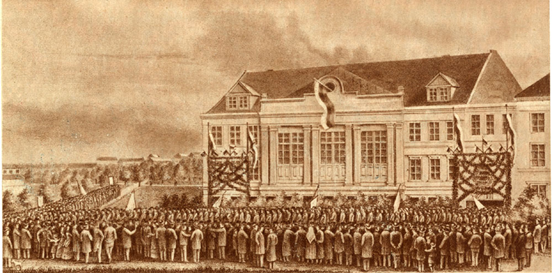
The first Latvian Song and Dance Festival parade on 1873 near the Riga Latvian Society Building
In late 19th Century Latvian National revival came to danger when Russian authorities decided to impose strict Russification laws on state services, schools and the press. It mobilized the Latvian nationalists. However, the Russification failed because Latvian national societies were strong and first private Latvian schools appeared. From the last years of 19th Century Marxism came to Latvia mobilizing Latvians against Tsarist tyranny. From 1886 to 1905 a leftist Latvian newspaper “Dienas Lapa” (Daily Sheet) was one of the main Latvian press organs. Its editors were Jānis Rainis (Pleikšāns) and Pēteris Stučka the future communist leader. The revolution of 1905 was the climax of the Latvian nationalism. Despite the fact that main pushers of the revolution were Latvian Social Democrats the revolution had national character it was an uprising against German-Russian tyranny.
When the First World War started Latvians were formed as a united nation and a few years later were ready for national independence.
Used Sources:
Dunsdorfs, Edgars. (1962) Latvijas vēsture, 1600-1710. Stockholm: Daugava.
Dunsdorfs, Edgars. (1964) Latvijas vēsture, 1500-1600. Stokholm. Daugava.
Bērziņš, Jānis (Ed.) (2000) Latvija 19. gadsimtā : vēstures apceres. Riga: Latvijas Vēstures institūta apgāds.
Hausmanis, Viktors (Ed.) (1998) Latviešu literatūras vēsture : 3 sējumos Volume 1. Riga: Latvijas Zinātņu akadēmijas Literatūras, folkloras un mākslas institūts.


Leave a Reply