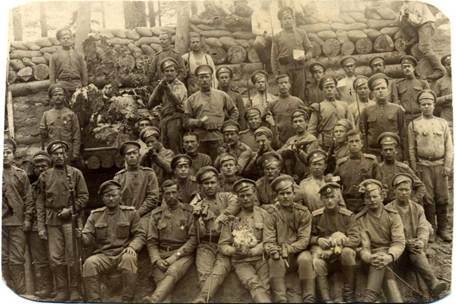
The Latvian Rifleman on 1916
In 1916 the territory of Latvia was divided by the German and Russian front line. From January 5 to January 11 a large battle took place in the swamps of Tirelis. The main attacking force was Latvian Rifleman who fought on Russian lines. The attack failed and Latvian units and Russians suffered heavy casualties. According to the old Russian Julian Calendar the battle took place between December 23 to December 29. That is why the battle is named after Christmas.
Russia joined the war against Germany in 1914. Already in August 1 after the German declaration of war German warships shelled the city of Liepaja. In July 30 on all territory of Latvia a mobilization was issued. Already in the first days of war 20 to 25 thousand Latvians were sent to the Eastern Front. On 1915 January 31 to February 21 Russians fought unsuccessful battle in Mazurian lakes and the town of Augustov. On 8 February the Baltic XX corpus was destroyed. From 35, 500 soldiers 27, 988 lost their lives. In all region Russians lost 42, 000 men. Later Russian officers remembered the outstanding performance of Latvian soldiers and their courage. Latvian losses were one of the largest in the history of the Latvian warfare.
On spring on 1915 German army marched in the Russian territory. They captured Lithuanian lands, and on May 7 took control of city Liepaja. However the heart of Semigallia the city of Jelgava was not taken because of Latvian Home Guards who stood against the Germans. The main defense lines were among Ruļlu hills and Svēte. Home Guards already showed their best against Germans in Lithuania and Germans was looking to find the best way to defeat them. After attack on Ruļlu hills failed Germans attempted to attack from Skrunda and was also fought back. Then Russian reinforcements came and stopped German offensive.
In July 14 Germans advanced from the river of Venta. This time only Russian units stood against them and retreated in a disorderly way. Jelgava was taken without a single gunshot. On August 1 Germans had captured all Courland, Semigallia and the front line stretched from the Gulf of Riga to the city of Daugavpils.
After the capture of half of Latvian territory the strongest voices of patriots called to form Latvian national units. The units must be formed only from Latvians and must have their own Latvian officers. The strong dislike for the Germans was the general reason for Latvians did not want the return of the German rule. Latvian activists contacted Russian military officials. The main pusher of this idea was the deputy of the Russian State Council Jānis Goldmanis. Many Russian officials resisted the idea, because of the memories of revolution in 1905 when Latvians were the strongest revolution force. Russian Empress Alexandra, an ethnic German recommended Czar Nikolai II to sent Latvian soldiers to other parts of Russia. However, because of the outstanding performance of Latvian Home Guards the Russian High command accepted the idea.
In the first days of forming 3700 men joined voluntarily, in the second half of 1915 there were 6392 volunteer soldiers. Eight Latvian battalions were later reformed in regiments. With the reserve regiment in Tartu there were 38, 100 Latvians Rifleman fighting in the Russian army. The formation of Latvian first national units was taken by great euphoria; this was different from the Latvian Waffen SS legion, because it was a pure Latvian initiative.
The front line as dangerously close to Riga. At a length of 90 kilometers, from the Dole Island in river Daugava, Berzmente-Dalbe-Mangaļi forest guard-house, the Swamp of Tīrelis, Ķemeri, Ragaciems to the shores of the Gulf of Riga a line of entrenchments and fortifications was established. Latvian Rifleman along with Russian soldiers guarded the city of Riga.
The German advance to Riga was stopped in October. Germans were surprised by the strength and courage of Latvian soldiers. Because of this Germans restrained from full blown attack against Riga for two years. Russians however ordered many attacks in the summer of 1916 which Latvians fought with heavy losses. The Russian High command was inefficient and issued foolish orders. In July, because of the bad situation in the Western front Russians were forced by the allies to attack Germans to relive the allied defense. Russians ordered badly planed attacks near the road to Bauska to advance to Baldone and Iecava. The attack was in daylight and soldiers entered the Smerdkuļa swamp. Artillery bullets got lost in the swamp dunes and German lines were untouched. Soldiers were exposed to machine gun fire. The Germans shelled the attackers and at the end of the day only the small part of the survivors reached the German entrenchments.
Heavy battles took place on the left side of the river Daugava still owned by Russians. The 2 km² wide peninsula was made as fortification for two battalions. On April 16 1916 two Latvian Rifleman Battalions were sent there to assist the Russian troops who defended this bridgehead. The Germans wanted to capture this small plot of land to gain crossing point over Daugava. The Latvian Rifleman was under constant artillery bombardment. On September 25 1916 Germans even used chemical gas weapons. However, the bridgehead was not captured by Germans until July 27 1917, when following the German offensive the bridgehead was evacuated. Both Latvian battalions lost 167 men. That’s why the bridgehead got its infamous name – The Island of Death.
However, the Russian High command planned more attacks. Bulgarian General Radko Dimitriev planned to use eight Latvian Rifleman Regiments to attack heavily fortified German lines in the night-time without artillery support. In December 12 General Dimitriev gathered the Latvian commanders and issued his plans. He lied about the seven times larger Russian forces and the great reserves. In reality the attack force was only three times larger. Latvian commanders were mostly optimistic and promised to carry out the attack with greatest confidence.
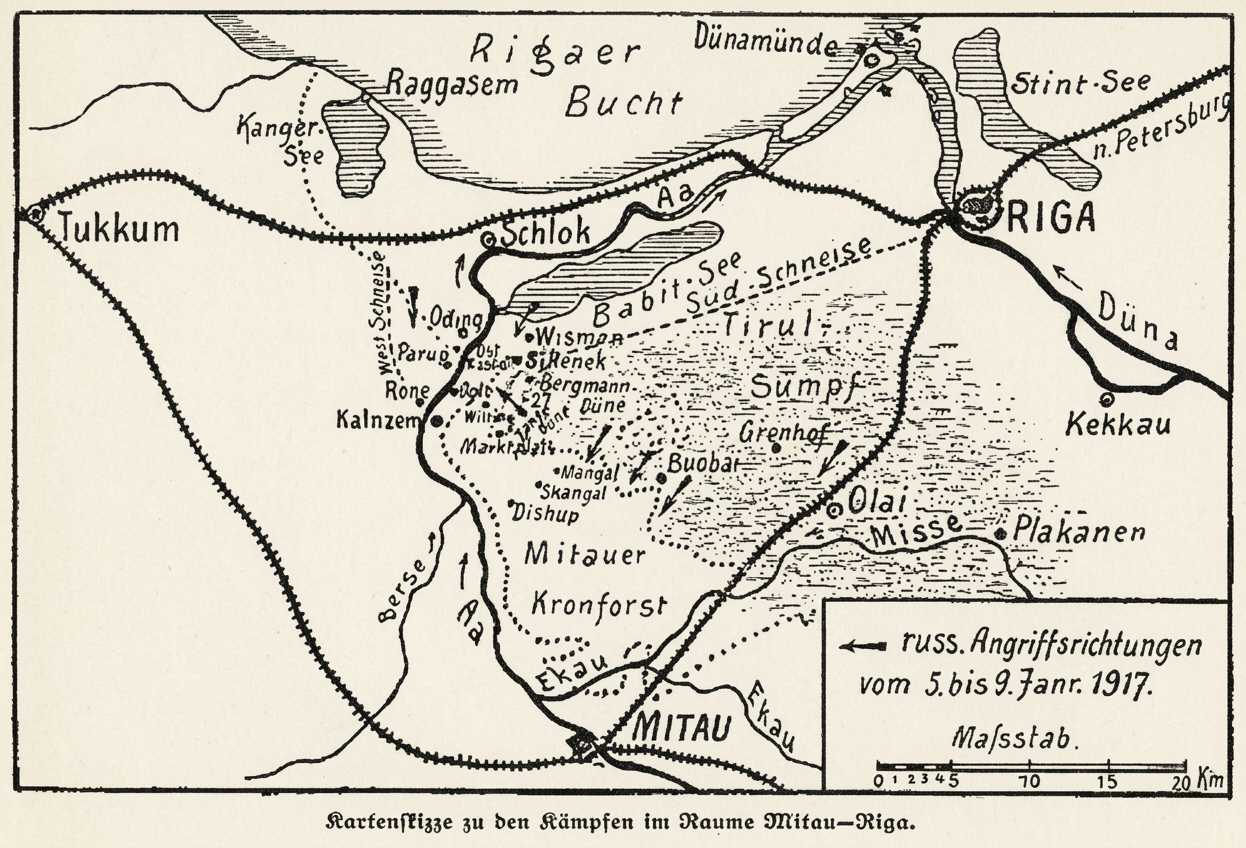
German map of the Riga front and Christmas Battles. AI enhanced image
Latvian soldiers were also optimistic and the Russian promises that they could liberate Jelgava boosted them. The spirits were high and nobody suspected that the attack was intended for much more local purposes and after they would break the first lines, Latvians without Russian support would have to face concrete or heavy rafter blockhouses and machine guns.
On the first day of battle temperature was around 0°, but on next days fell down to 25º to 30º. Wounded or sleeping soldiers froze to death. Latvians were ordered to capture the first German lines to open way for reinforcements. By the cover of snowstorm and arctic outfits Latvians cut passages trough the barbed wires. After that they rushed to the first German battle line. Next two days were spent on heavy fighting and the second battle line was captured. The attack was halted because there was no Russian reinforcements and Siberian units refused to assist Latvians.
The Germans started a heavy counterattack. It was withstood for 48 hours. Then on January 7 Latvian rifleman attacked heavily fortified German lines in the sand dunes of Tireli swamp. In the middle of the German fortification was the fortified hill that later was called Ložmetējkalns (Machine Gun Hill). Along with Siberian unit’s Latvian rifleman captured this fort. About 1000 German men were captured. The outcome of the attack was 7 km wide gap on the German front lines. But, no supportive attack from Russians ever took place.
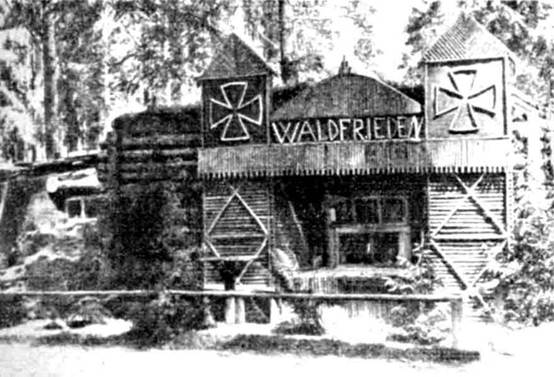
The German fortifications at the Machine Gun hill
On January 23 Germans gathered forces for the counter attack. In the temperature of -48º Latvian Rifleman along with Siberian divisions were left alone to face the Germans. Russians ordered three counter attacks that all failed. In so Germans recaptured 4/5 of their lost positions. However, the Machine Gun hill remained in the hands of the Russians.
The courage of Latvian Rifleman was known far outside Russia, because of this battle. However, the broken promises by the Russians turned down the morale of Latvian officers and soldiers. The foolishness of the Russian commanders and cowardice of the Russian soldiers was clearly visible. The Russian command sent Latvian to death on purpose, because they did not trust them and Latvians were the only ones who were truly capable to fight. Understandably the soldiers from Siberia did not see any point to fight on land that they did not consider their homeland. But, for Latvians it was the fight for their very own land.
Front lines were broken only in the summer of 1917. Because of the fall of the Czarist government, the Germans captured Riga. Latvian rifleman’s again showed courage and managed to hold the Germans back. But, it only helped the panicky retreating Russians to leave untouched. This was the last time Latvian Rifleman fought for Russia. The sense of hopelessness led to the radicalization of the Latvian Rifleman. The majority of them showed support for the Bolsheviks and on the next years were the core of the Red Army. Those who stayed later fought in the Latvian Army in the war of freedom.
The site of the Christmas Battle the Tireli swamp was drained during the inter war period. After the regaining of independence a museum dedicated to the battle site was brought up. A dozens of entrenchments and bunkers are restored and dozens of people visit this site every year.
Used Sources:
Bērziņš, Valdis. (1995) Latviešu strēlnieki: drāma un traģēdija. Riga : Latvijas Vēstures institūta apgāds.
Bērziņš, Valdis. (2000) 20. gadsimta Latvijas vēsture. I, Latvija no gadsimta sākuma līdz neatkarības pasludināšanai, 1900-1918. Riga: Latvijas vēstures institūta apgāds.
Lācis, Visvaldis (2001) Latviešu zemes un tautas vēsture. Rīga : ASF Saules koks : Vieda.


Leave a Reply