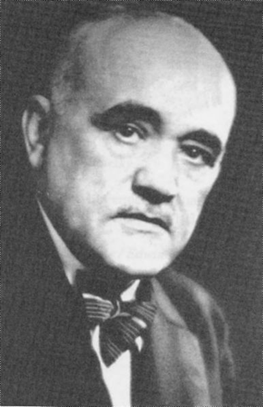
Paul Schiemann the political leader of the Baltic Germans
In late Medieval age Holy German Empire became overpopulated. People had trouble finding land and jobs in the cities. In families with more than two children the third son was unable to inherit land from his family. So many Germans had to find a new place to live. The Germans looked to the east. Eastern Europe offered free lands to maintain and local people were poor and in much lower numbers. Also the Eastern European kings needed immigrants from the west to protect their lands from Mongolian invasions. This allowed the Germans to migrate to such places as Transylvania (in present day Romania), Bohemia (Sudetenland, Czech Republic) and other eastern parts. Later on the behalf of empress Katrina II Germans entered Russian lands.
But nobody invited Germans to Baltic lands. In 12-13 century Germans started a military expansion to the east under Crusader banner. Crusades in Latvia have been discussed in many posts before this book.
First Germans in Latvia were Crusaders and Church missionaries. Along with them came German merchants that settled in Riga. When all Latvian land became part of Livonia, more Germans came here. Crusaders became nobles and established castles around Latvia. Others mainly merchants lived in larger cities. In the 13th century there were 15 thousand Germans opposite to 160 thousand ancient Latvians. Also 20 thousand Livonians lived in Latvia. Despite the low numbers Germans were political majority. They held all political rights and titles; they got rights to land and ownership of local peasants. Ancient Latvians were mostly peasants that worked for German landlords all their life with no rights for their own land. Latvians got little chance for education that would raise their social status. In cities Latvians could only have low rank jobs that were called “shameful jobs”. But Latvia escaped high scale colonization of German peasants. Livonia was hard to reach from Germany because of independent Lithuania and the Baltic Sea. If the Germans would enter Latvia in larger masses than Latvians would put at high risk of assimilation. There are however records of Latvian and Livonian entry into German noble families. One of the most famous Baltic German noble family Fon Lieven is said to originate from Livonians.
During the time of Reformation most Germans supported Martin Luther reforms and became Lutherans. Lutheranism and other protest movements were highly common among German immigrants in Eastern Europe. Swift to Lutheranism also helped Latvians for the first religious texts were translated into Latvian.
The shock to the German nobility was Livonian war that started in 1558. Livonia was at risk of being conquered by Russia. That did not happen thanks to Poland-Lithuania and Sweden, but the Germans had to give up their Crusader order. In 1561 the Livonian order ceased to exist. However Germans managed to keep all their rights because of the favor by Polish king Sigismund Augustus. A document containing promised privileges by Polish king gave wide rights to Germans in Latvia. But this document has not preserved until this day and nobody hasn’t seen it for a long time. Because of this historians speculate that document is falsification. Despite that Germans used this phantom document to protect their rights for many years.
However Poles did not keep all promises. Riga faced trade controls from Polish administration. Poles tried to restore Catholicism by removing few churches and imposing new calendar. This caused Calendar revolt in Riga that lasted from 1584 to 1589 and was defeated with the help of traitors within Germans. But in Duchy of Courland and Semigallia that was autonomous from Poland Germans had time of their lives. Germans ruled the Duchy and had a free hand in politics and religious matters. Their best days ended in 1795 when Duchy was added to Russia.
Germans in Swedish Vidzeme faced hard times when the Swedish administration decided to revise German ownerships and give large portions of land to Swedes. But in Riga Germans were supported because Sweden needed to keep the favor of Riga that got larger population than Stockholm. The Germans build many beautiful trade residences in Latvia like Reitern house and House of Danenstern in Martalu Street.
After Vidzeme capitulated to Russia things changed. One side of Germans led by count Johann Patkul conspired against Sweden to support Russia. However many German nobles were part of Swedish army and captured Patkul and sentenced him to death. But Russia at first did not want to conflict with the Germans. General Sheremtjev signed deal with Germans to allow them autonomy and official use of the German language. Latvians were completely subjected to Germans. Taxes and curves were increased. This was the highest point of Latvian enslavement that continued many decades until serfdom was abolished.
Russian emperor Peter I favored German aristocrats. He invited them to his court at Petersburg. The new city itself was built with the help of German engineers. Peter I needed well-educated Germans modernize his new empire.
In the 18th century there were 40 thousand Germans in Latvia. Because of Enlightenment in Western Europe many intellectuals entered Latvia most notably Johan Herder who worked in the Riga Dome School. German scholars started to show interest for Latvian folklore and language. Ernest Glik did tremendous work of translating the Bible in Latvian. Pastor Gothart Stender wrote many educational books in Latvian promoting Latvian education. Favored among Latvian are German scholar Garibl Merkel and his work “Latvians”. In this book he criticizes the Latvian enslavement and the praises Latvian culture. This was one of the first times when information about Latvians was shown to the outside world. The work of German educators helped Latvians to get a national identity in future.
In 1766 first and last attempt of German colonization happened in Latvia. By the favor of empress Katrina II 85 Germans from Pfalz settled in Hirchen (Irši) Paris near Aizkraukle. All of them were peasants who lived closely in Hirchen village. In 1914 there were a 8000 people who were born in Hirchen. However only 1570 lived there because others left home to find luck in Riga, Russia or in Western Europe.
Germans living in Latvia often did not call themselves Germans. They identified themselves as Baltic Germans (deutchbalten). In 1817 and 1819 serfdom was abolished in Courland and Vidzeme (but still in Latgalia). German educators put even higher pressure to educate Latvians. They however wanted only elementary education for them. Latvians peasants still were objected to German landlords despite the abolishment of serfdom. That caused rapid Latvian conversion to the Orthodox Church to move away from the Germans. About 40397 Latvians became Orthodox Christians. To stop this leader of liberal German reformists Hamilkar von Felkerzam managed to allow Latvians rent land from the Germans and require it in longer time. This finally allowed Latvians to become farmers.
The Germans got high influence in Russian politics. The Russian army was filled by German high rank officers. The Germans took posts in the Russian government. German academics and scientists pushed Russian progress. Only Noble prize winner from Latvia is German chemist Wilhelm Ostvald. In middle of 19th century 140 thousand Germans lived in Latvia. They took part in the industrialization and controlled all industrial sectors in Latvia. They were wealthiest social group. But the growing sentiment of Russian nationalism or Slavophilism started to push pressure on the Germans. Russian Tsar Alexander II started the process of Russifaction and Unifaction of Russian Empire. In 1885 Nikolay Manasein revision cancelled the Baltic German autonomy, abolished German courts and made Russian language the official language in state matters. Baltic Germans did not receive any support from German Empire that wanted to keep good relations with Russia. 2000 Baltic Germans emigrated to Germany because of anti-German reforms. However Germans kept their status in industrial and commercial sector. They still worked in state offices because Russians were not eager to work in the Baltic provinces. All Majors of Riga were Germans (except Englishman John Armisted) no Russian ever wanted to lead Riga.
The Germans felt remorse to Latvians who gained more freedom because of Russian reforms. However the wave of Russifaction hit Latvians by prohibiting the Latvian language in schools and public places. But Latvians were free to form their organizations and speak privately in Latvian. When wave of revolution hit Latvia in 1905 the Latvian-German conflict sparkled in blood and fire. For the few months Russian administration lost control over Latvian rural areas that were taken by revolutionary committees. Revolutionaries burned 200 German mansions in all Latvia. The Germans formed self defense squads to fight armed social democrats and peasants. When things begun to heat up; Germans asked for Russian help. General Aleksey Orlov led “punitive expeditions” to stop revolving. Punishment battalions killed 1615 revolutionaries.
A new hit for Germans were the start of First World War. The Germans suddenly become haunted minority blamed for all calamities of the war. Russian administration destroyed the prosperous German controlled industry by evacuating all factory equipment to inner Russia. Even tram lines were taken to Russia. Despite this a large part of Germans fought with the Russian army against their brothers in Baltic front.
A new hope for the Germans was Brestlitovsk peace agreement that gave all Baltic lands to Germany. On November 8 1918 Baltic Germans gathered in Riga to proclaim the “Baltic State”. This state should compromise Estonia, Latvia and Lithuania and restore all rights for Germans. However in November 11 Germany signed capitulation act and in November 18 Latvia proclaimed its independence. The idea of Baltic State now was obsolete. Germans however did not lose hope for it until 1920. In 1918 Germans supported Latvian government because of growing danger from Soviet Russia. Germans made Landesver an army from Baltic Germans and ex members of the German army to help the Latvian army. With their help the Bolsheviks were pushed away from Riga however Germans quickly turned against Latvians by organizing coup 1919 April 16 in Liepaja. A plan to capture Karlis Ulmanis government failed and Germans formed a puppet government lead by Kārlis Niedra a pro-German pastor. Their plans failed completely when their armed forces were defeated by joint Latvian and Estonian forces near Cesis on June 22. By pressure of the US, England and France a ceasefire was signed and the Germans were forced to recognize the Latvian government. Germans Edvin Magnuss become minister of justice and Robert Erhard became minister of finance. Landesver was taken under Latvian control.
However radical German forces lead by General Ridiger von der Goltz and Russian whiteguard Pavel Bermont- Avalov attacked Riga in November of 1919 but failed once again. By this time more Germans supported Latvia. Paul Schiemann new German leader officially supported Latvian independence. Landesver forces took part in the liberation of Latgalia in 1920 from the Soviets. 54 German soldiers were awarded with the highest Latvian military award the Order of Lachpesis (Bear slayer).
In 1989 by Soviet Census there were 3789 people calling them Germans. A large part of them came from mainland Russia. Only 944 were born in Latvia. 49% of Latvian Germans spoke only in Russian. After regaining of independence Germans organized new organizations, but there is a divide between German-speaking Germans and Russian speaking Germans. By the dates of 2007 there are 4226 Germans in Latvia. Some Germans from Germany move to Latvia to find jobs or move here because they married with Latvians. The last census in 2011 gathered 3042 Germans now living in Latvia.
German culture in Latvia has been destroyed by two-world wars. But the German presence can be seen in many places in Latvia. The buildings in Riga, mansions in rural areas. Latvian language and music have been influenced by the Germans. Latvians despite the conflicts own a lot of Germans and German factor will always have a place in Latvian history.
Used Sources:
Krupņikovs, Pēteris. (1980). Melu un patiesības palete. Riga: Zvaigzne 1980.
Duhanovs, Maksims. (1986). Baltijas muižniecība laikmetu maiņā : Baltijas muižniecības politika 19.gs. 50.-70.gados un tās apoloģētiskās historiogrāfijas kritika. Riga: Zinātne.
Dribins, Leo, Spārītis Ojārs. (2000) Vācieši Latvijā. Riga: Latvijas Universitātes Filozofijas un socioloģijas institūts. Etnisko pētījumu centrs.
Dribins, Leo (Ed.) (2007) Mazākumtautības Latvijā : vēsture un tagadne. Rīga : Latvijas Universitātes Filozofijas un socioloģijas institūts, 2007.
Pistohlkors, Gert, Von. (Ed.) Deutsche Geschichte im Osten Europas: Baltische Länder, Vol 4.Berlin: Seidler Verlag.
Cerūzis, Raimonds (2004). Vācu faktors Latvijā (1918-1939) : politiskie un starpnacionālie aspekti = German factor in Latvia (1918-1939) : political and inter-ethnic aspects. Rīga : LU Akadēmiskais apgāds.
 Latvian History
Leave a comment